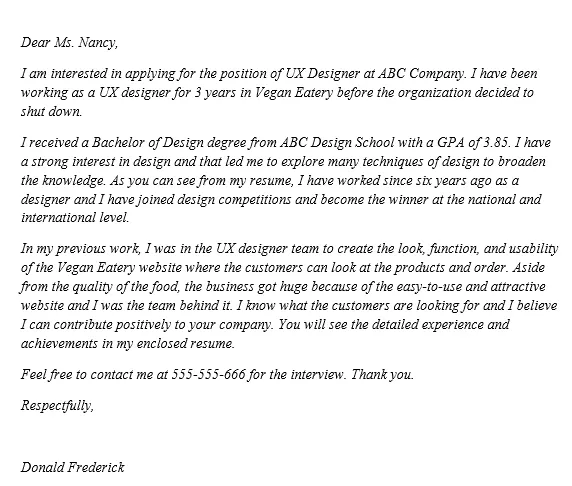
UX Research Cover Letter Structure
A well-structured UX Research cover letter is your gateway to landing an interview. It’s a chance to showcase your skills, experiences, and passion for user experience. Following a clear structure helps you present your qualifications effectively and make a strong first impression. A standard cover letter typically includes several key sections, each serving a specific purpose. These sections work together to tell your story and demonstrate why you are the ideal candidate for the role. By mastering this structure, you can significantly increase your chances of success and stand out from the competition. Remember that tailoring your cover letter to the specific requirements of each job is crucial for maximizing its impact.
Header & Contact Information
Start your cover letter with a professional header that includes your full name, contact information (phone number, email address, and LinkedIn profile URL), and the date. Ensure your contact details are accurate and up-to-date to facilitate easy communication from potential employers. Including a LinkedIn profile is particularly important as it provides a quick way for hiring managers to learn more about your professional background and experience. This section sets the tone for the rest of your letter, so presentation matters. Make sure everything is clearly formatted, easy to read, and visually appealing. Consistency in this area reflects your attention to detail, which is a crucial skill in UX Research.
Personalized Greeting

Address the hiring manager or recruiter by name if possible. Doing so shows that you have taken the time to research the company and are genuinely interested in the opportunity. Generic greetings, such as “To Whom It May Concern,” are often perceived as impersonal. If you cannot find a specific name, try looking on LinkedIn, the company website, or contacting the HR department to get it. If a name remains elusive, the next best option is a role-specific greeting, like “Dear Hiring Manager.” A personalized greeting immediately makes your letter more engaging and demonstrates your proactive approach, setting a positive tone from the start.
Opening Paragraph
The opening paragraph should immediately grab the reader’s attention. State the specific position you are applying for and briefly mention where you found the job posting. Then, provide a concise overview of why you are interested in the role and the company. Highlight your most relevant skill or experience that aligns with the job requirements. This is your first opportunity to show your value proposition. Keep it brief and compelling; avoid overly long or generic introductions. Aim to create an immediate connection by demonstrating your understanding of the company’s needs and your ability to contribute effectively.
Highlight Relevant Skills & Experience
In the main body of your cover letter, highlight the skills and experiences that directly relate to the UX Research position. Use specific examples to illustrate your abilities and achievements. This is where you showcase your ability to conduct user research, analyze data, and communicate findings effectively. Focus on the skills and experiences mentioned in the job description, tailoring your content to align with the company’s specific requirements. Describe how you have successfully used your skills in past projects, quantifying your contributions whenever possible. The key is to show, not just tell, your qualifications by providing tangible evidence of your expertise.
Quantify Your Achievements

Whenever possible, quantify your achievements. Use numbers, percentages, and data to demonstrate the impact of your work. For example, instead of saying “Improved user satisfaction,” state “Increased user satisfaction by 20% through usability testing and redesign.” Quantifying your accomplishments makes them more credible and demonstrates your ability to deliver tangible results. This provides concrete evidence of your contributions and helps the hiring manager understand the value you can bring to their team. By highlighting the impact you have made in previous roles, you show that you can replicate similar success in the new position.
Showcase Your UX Research Skills
UX Research roles require a unique blend of skills, so emphasize your abilities in this area. Mention your experience with different research methodologies, such as user interviews, surveys, usability testing, and A/B testing. Highlight your proficiency in using research tools and software, like user analytics platforms, survey tools, and prototyping software. Showcase your ability to analyze data, create reports, and communicate findings effectively. Also, highlight your problem-solving skills, attention to detail, and ability to work collaboratively with cross-functional teams. Demonstrate how you have used your research skills to make data-driven decisions and improve user experiences.
Mention Company & Position
Express your interest in the specific position and company. Show that you have researched the company and understand its mission, values, and products. Explain why you are excited about the opportunity and how your skills align with the company’s goals. Mention specific projects or aspects of the company that resonate with you. This personalization demonstrates your genuine interest and initiative, setting you apart from other applicants. By demonstrating your knowledge of the company, you show the hiring manager that you’re not just applying for any job; you are specifically interested in this opportunity.
Express Enthusiasm & Passion

Convey your enthusiasm and passion for UX Research. Let your personality and excitement for the field shine through. Explain why you are passionate about user experience and how you enjoy solving user problems. This enthusiasm will make your cover letter more engaging and memorable. Use language that conveys your genuine excitement for the role and the company. Highlighting your passion can create an emotional connection with the hiring manager and make them more likely to consider your application favorably. Remember, employers seek candidates who are not only skilled but also genuinely enthusiastic about their work.
Closing Paragraph & Call to Action
Conclude your cover letter with a strong call to action. Express your interest in an interview and provide your contact information again. Thank the hiring manager for their time and consideration. Reiterate your enthusiasm for the opportunity and the company, and let them know you are eager to discuss your qualifications further. This shows you are proactive and ensures the hiring manager knows how to contact you. A clear call to action reinforces your interest and increases the likelihood of receiving a response.
Formatting Your UX Research Cover Letter
Proper formatting is essential for a professional-looking cover letter. Choose a clean and readable font, such as Arial, Calibri, or Times New Roman, and use a font size between 10 and 12 points. Use standard margins (1 inch on all sides) and single-space the body of the text. Break up large blocks of text with paragraphs and bullet points to improve readability. Use headings and subheadings to organize your content logically and make it easier for the hiring manager to scan. A well-formatted cover letter demonstrates your attention to detail and professionalism, which are essential qualities in UX Research.
Choose the Right Font and Size

Select a font that is easy to read and professional. Avoid overly stylized fonts that can distract from your content. Common and appropriate choices include Arial, Calibri, Times New Roman, and Helvetica. The font size should be between 10 and 12 points, as this ensures readability without taking up too much space. The goal is to make your cover letter as easy to read as possible, which is a reflection of your attention to detail, which is key in UX Research.
Proofread and Edit Thoroughly
Proofread your cover letter carefully for any typos, grammatical errors, and inconsistencies. Ask a friend or colleague to review your cover letter as a second pair of eyes can catch mistakes you may have missed. Pay attention to punctuation, sentence structure, and spelling. Errors can damage your credibility and make you seem unprofessional. Thorough proofreading is critical; it ensures that your cover letter presents you in the best possible light and demonstrates your attention to detail.
UX Research Cover Letter Examples
Reviewing cover letter examples can provide valuable insights and inspiration. Look for examples that are relevant to your experience level and the type of role you are applying for. Study how other UX Researchers have structured their letters, highlighted their skills, and showcased their achievements. However, always remember to tailor the examples to your own experiences and the specific requirements of each job. Do not simply copy and paste; customize the examples to accurately reflect your qualifications and personality. Analyzing examples will help you understand how to frame your skills and experiences effectively.
Entry-Level UX Research Cover Letter

For entry-level positions, focus on showcasing relevant academic projects, internships, and any volunteer work related to UX Research. Highlight transferable skills, such as problem-solving, communication, and data analysis. Explain your passion for UX Research and your willingness to learn. Mention any coursework, workshops, or certifications that demonstrate your foundational knowledge. Focus on how your education and any related experiences have prepared you to excel in this position. Show enthusiasm for UX Research and your ability to quickly adapt and contribute.
Experienced UX Research Cover Letter
Experienced UX Researchers should focus on showcasing their accomplishments and the impact of their work. Provide specific examples of successful research projects, highlighting the methodologies used, the insights gained, and the outcomes achieved. Quantify your results whenever possible to demonstrate your contributions. Mention any leadership roles, such as mentoring or managing research teams. Tailor your letter to the specific requirements of the job and provide data that shows your ability to add value. Demonstrate your ability to drive impactful results through your research.
Tailoring Your Cover Letter
Customizing your cover letter for each job application is crucial. Avoid sending generic letters; instead, tailor your content to align with the specific requirements and responsibilities of the role. Review the job description carefully and identify the key skills and experiences the employer is looking for. Use this information to highlight your relevant qualifications and explain how your background aligns with the company’s needs. This will make you stand out from the competition. Personalization is the key to making your cover letter effective and memorable.
Researching the Company
Before writing your cover letter, research the company and the position thoroughly. Visit the company website, review their social media profiles, and read news articles and industry publications related to the company. This will give you valuable insights into the company’s mission, values, and culture. Mentioning specific projects, initiatives, or aspects of the company that appeal to you demonstrates your genuine interest and helps you connect with the hiring manager. Tailoring your letter shows that you are interested in more than just a job. This will make your cover letter more impactful and memorable.
Matching Skills to Requirements
Carefully compare your skills and experiences with the requirements listed in the job description. Identify the keywords and phrases used in the description and incorporate them into your cover letter. Highlight the skills and experiences that directly align with the job responsibilities. Provide specific examples that demonstrate your ability to perform the required tasks and achieve desired outcomes. Tailoring your cover letter will demonstrate your ability to meet the requirements of the position. Showing that you understand the company’s needs and can provide the skills required is essential.
UX Research Cover Letter Mistakes to Avoid
Avoid common mistakes that can hurt your chances of getting an interview. Generic cover letters, typos, and a failure to highlight achievements are all major red flags. Make sure your letter is well-written, tailored to the specific job, and showcases your qualifications effectively. Correcting these common errors can greatly enhance your chances of success. Pay close attention to detail and take the time to ensure your cover letter is polished and error-free.
Generic Cover Letters
Avoid sending generic cover letters that are not tailored to the specific job. Such letters often come across as impersonal and demonstrate a lack of interest in the company. Customize your cover letter for each application to show that you have done your research and are genuinely interested in the position. Generic content does not demonstrate your understanding of the company or your suitability for the role. Personalizing each letter increases the likelihood of capturing the hiring manager’s attention and securing an interview.
Typos and Grammatical Errors
Typos and grammatical errors can undermine your credibility and make you appear unprofessional. Proofread your cover letter carefully for any errors in spelling, grammar, and punctuation. Ask a friend or colleague to review it before you submit it. Correcting these common errors will ensure that your cover letter reflects your attention to detail and professionalism.
Failing to Highlight Achievements
Avoid simply listing your job duties without highlighting your achievements. Focus on what you accomplished in your previous roles, and quantify your results whenever possible. Use specific examples to demonstrate your skills and showcase the impact of your work. The goal is to show the hiring manager the value you can bring to the team. Demonstrating your achievements makes your cover letter more compelling and memorable.
Final Thoughts
Writing a compelling UX Research cover letter is essential for landing your dream job. By following the guidelines outlined in this guide, you can craft a cover letter that showcases your skills, experiences, and passion for UX Research. Remember to tailor your letter to each job, highlight your achievements, and proofread carefully. Good luck with your job search. Your cover letter is your chance to make a strong first impression and show the hiring manager that you are the perfect candidate.