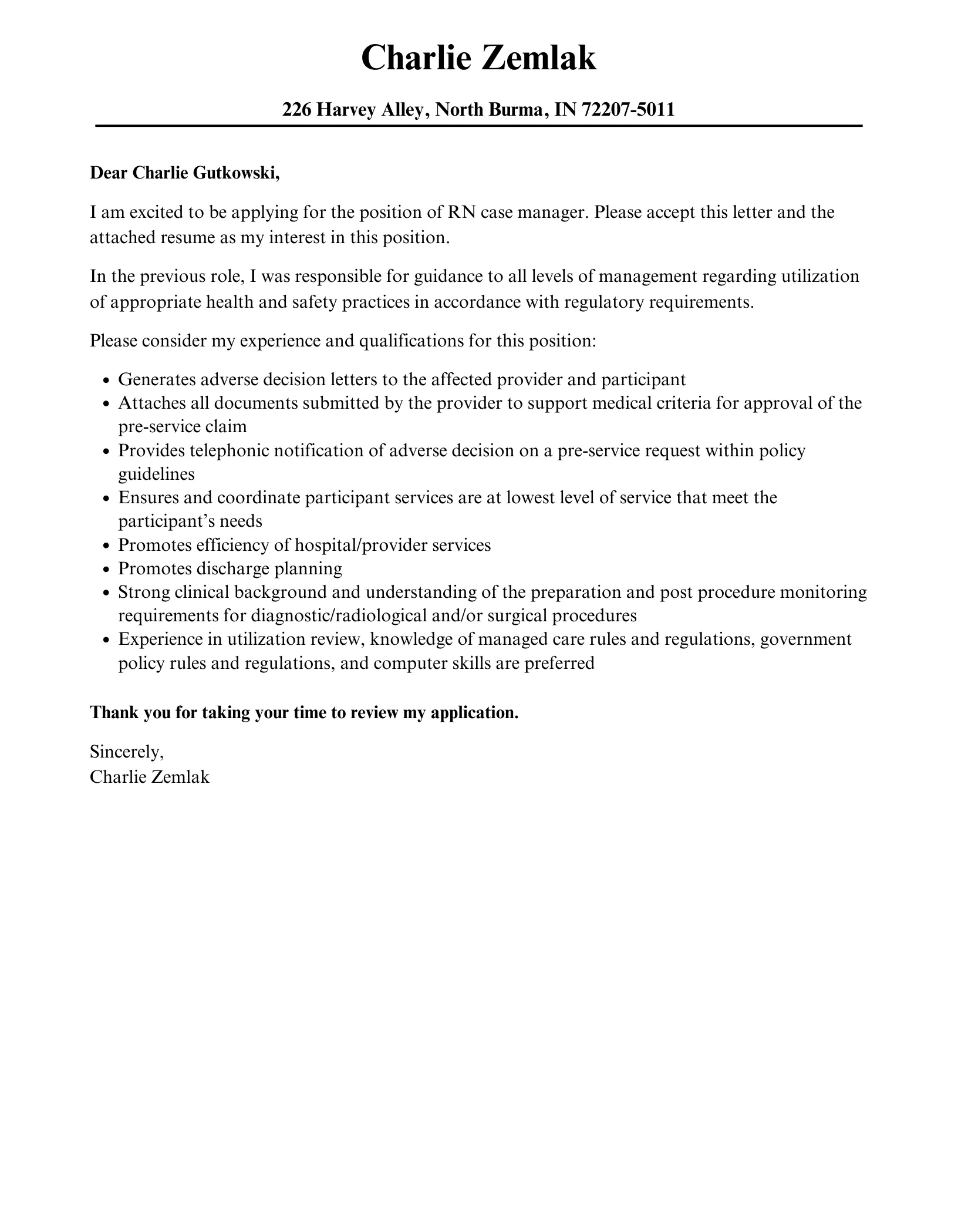
Why a Strong RN Case Manager Cover Letter Matters
As an RN Case Manager, your expertise in patient care coordination, resource allocation, and discharge planning is crucial. However, your resume alone might not fully capture the nuances of your skills and your passion for this role. That’s where a well-crafted cover letter steps in. It’s your first opportunity to make a strong impression, showcasing not just your qualifications but also your personality, work ethic, and genuine interest in the specific position and organization. A compelling cover letter can significantly increase your chances of securing an interview and ultimately, the job. It allows you to personalize your application, demonstrating that you’ve taken the time to understand the employer’s needs and tailor your application accordingly. This proactive approach sets you apart from other applicants and highlights your commitment to excellence in the field of case management.
Highlighting Your Skills and Experience
Your cover letter is the perfect platform to spotlight the skills and experience that make you an ideal RN Case Manager. Go beyond simply listing your qualifications; provide concrete examples that demonstrate your abilities in action. Focus on the aspects of your experience that directly align with the job requirements. This targeted approach ensures that the hiring manager immediately recognizes your suitability for the role. Be specific and detailed when describing your past experiences, emphasizing the impact you made and the results you achieved. This approach will make your application more memorable and increase your chances of progressing to the interview stage. Remember, the goal is to paint a vivid picture of your capabilities, allowing the employer to envision you as a valuable asset to their team.
Key Skills to Showcase

RN Case Managers require a diverse skill set to effectively manage patient care. In your cover letter, highlight skills such as critical thinking, communication, and problem-solving. Mention your experience with care coordination, discharge planning, utilization review, and patient advocacy. Demonstrate your proficiency in electronic health records (EHR) systems and your ability to work collaboratively with interdisciplinary teams. Don’t just list these skills; provide brief examples of how you’ve utilized them in previous roles. For example, you could explain how your strong communication skills helped resolve a conflict between a patient and a provider, or how your critical thinking skills improved the efficiency of a care plan. Tailor these skills to align directly with the job description, showcasing your relevance to the specific role.
Experience to Emphasize
When describing your experience, focus on the roles and responsibilities that align with the requirements of the RN Case Manager position you’re applying for. Mention the types of patients you have worked with, the settings in which you’ve practiced (hospital, clinic, home health, etc.), and the specific programs or initiatives you’ve been involved in. Detail your experience with case management processes, including assessment, planning, implementation, and evaluation. Showcase your ability to manage a caseload efficiently, prioritize tasks effectively, and meet deadlines. If you have experience in a specialized area of case management, such as oncology, cardiology, or pediatrics, be sure to highlight this. Emphasize any leadership roles you’ve held or any achievements you’re particularly proud of in your previous positions.
Quantifying Your Achievements
Numbers speak volumes. Whenever possible, quantify your achievements to demonstrate your impact in previous roles. Instead of saying, “Improved patient satisfaction,” state, “Increased patient satisfaction scores by 15% through proactive communication and personalized care plans.” Similarly, quantify your efficiency and cost-saving efforts. For example, “Reduced hospital readmission rates by 10% through effective discharge planning and patient education.” or “Managed a caseload of 50 patients, consistently meeting or exceeding productivity targets.” Quantifying your achievements provides concrete evidence of your value and shows hiring managers the tangible results you can bring to their organization. This data-driven approach strengthens your cover letter and sets you apart from other candidates.
Tailoring Your Cover Letter

A generic cover letter is unlikely to impress hiring managers. Tailoring your letter to each specific job application is crucial. This shows that you have taken the time to understand the requirements of the role and the values of the organization. Begin by carefully reviewing the job description and identifying the key skills, experiences, and qualifications the employer is seeking. Then, customize your cover letter to highlight the aspects of your background that directly align with these requirements. Show how your skills and experience make you a perfect fit for this particular position. Personalize your letter by referencing the employer’s mission, values, or recent initiatives, demonstrating your genuine interest in the organization.
Researching the Employer
Before writing your cover letter, conduct thorough research on the employer. Visit their website, read news articles, and check their social media profiles. Understand their mission, values, and recent accomplishments. This research will allow you to personalize your letter and demonstrate your genuine interest in the organization. Find out about their approach to case management, their patient population, and their specific challenges. Mention any recent programs or initiatives that resonate with you. Show that you understand their needs and that you are excited about the opportunity to contribute to their mission. Mentioning specific programs or values is a fantastic method to show your interest and will increase your chances of getting an interview.
Customizing to the Job Description
The job description is your guide. Carefully review the job description and use it as a roadmap for your cover letter. Identify the key requirements and tailor your letter to address them directly. Use keywords and phrases from the job description to demonstrate that you understand the role and its responsibilities. Highlight your skills and experiences that match the requirements. Instead of simply stating that you have experience with care coordination, explain how your experience aligns with the specific duties outlined in the job description. By tailoring your letter to the job description, you demonstrate that you are a thoughtful and attentive candidate and are very likely to be a suitable match for the position.
Formatting and Presentation

A well-formatted cover letter is as important as its content. The presentation of your letter reflects your professionalism and attention to detail. Use a clear, readable font, such as Times New Roman, Arial, or Calibri, and maintain consistent formatting throughout. Use 1-inch margins and single-space your text, leaving a blank line between paragraphs for readability. Ensure your letter is free of grammatical errors and typos. A clean, well-formatted cover letter is easy to read and conveys a sense of professionalism that will impress hiring managers. Also, make sure that you check all the requirements such as font size and the format of the document which is generally a PDF.
Choosing the Right Tone
The tone of your cover letter should be professional, enthusiastic, and confident, without being overly assertive. Use a respectful and positive tone, and address the hiring manager by name whenever possible. Highlight your enthusiasm for the position and the organization. Convey your confidence in your ability to perform the job successfully, but avoid sounding arrogant. Be genuine and let your personality shine through, but maintain a professional demeanor. Reflect on your genuine interest in the position, but also ensure that you make a good impression, this will increase your chances of being called for an interview.
Formatting Best Practices
Follow standard business letter format for your cover letter. Include your contact information at the top, followed by the date and the employer’s contact information. Address the letter to the hiring manager by name, if possible. Use a clear and concise structure, with a strong opening paragraph that states your purpose, followed by body paragraphs that highlight your skills and experience, and a closing paragraph that reiterates your interest and includes a call to action. Keep your cover letter concise, ideally no more than one page. Ensure your letter is free of spelling and grammatical errors. Use a professional font and formatting for a polished look.
Proofreading and Editing

Proofreading and editing are critical steps in the cover letter writing process. Errors in your cover letter can damage your credibility and may lead to your application being rejected. Proofread your letter carefully for any spelling, grammatical, or punctuation errors. Read your letter aloud to catch any awkward phrasing or unclear sentences. It’s also a good idea to have someone else review your cover letter. Another pair of eyes can often spot errors that you might miss. Ensure that your letter is easy to read and conveys your message effectively.
Common Mistakes to Avoid
Be aware of the common mistakes that can undermine your cover letter. Avoid using generic templates that don’t address the specific job or employer. Don’t make any typos or grammatical errors, as this shows a lack of attention to detail. Avoid the use of jargon or overly technical language that the hiring manager may not understand. Do not simply reiterate your resume; instead, elaborate on your experiences and accomplishments. Do not make any negative statements about previous employers or colleagues. Remember to tailor your letter to the specific job and employer. Addressing these mistakes will help you create a strong and effective cover letter.
Seeking Feedback
Before submitting your cover letter, seek feedback from trusted sources. Ask a friend, family member, or career counselor to review your letter and provide constructive criticism. Ask them to check for clarity, conciseness, and overall effectiveness. Also, ask them to look for any errors in grammar, spelling, and punctuation. Consider having a professional review your cover letter. A career counselor or resume writer can provide valuable insights and help you create a polished and impactful document. Be open to feedback and make revisions as needed. Seeking feedback can significantly improve the quality of your cover letter and increase your chances of landing an interview.
Call to Action and Closing

End your cover letter with a strong call to action. State your interest in the position and reiterate your enthusiasm for the opportunity. Clearly indicate how you can be reached for an interview. Thank the hiring manager for their time and consideration. Express your confidence that you are a strong candidate and that you are eager to learn more about the role. Closing on a positive and proactive note will leave a lasting impression and increase your chances of receiving a response.
Expressing Enthusiasm
Show genuine enthusiasm in your closing paragraph. Express your excitement about the prospect of joining the organization and contributing to their mission. Let the hiring manager know that you are passionate about case management and that you are committed to providing excellent patient care. Briefly restate why you are a good fit for the role, highlighting your key skills and experiences. This will reinforce your message and leave a positive impression. Also, remember to proofread your text before submission to ensure no grammatical errors.
Providing Contact Information
Ensure that your contact information is clearly provided in your cover letter. Include your full name, phone number, and professional email address. Make it easy for the hiring manager to reach you. Verify that your contact information is up-to-date and that your voicemail is set up professionally. Also, consider including a link to your LinkedIn profile, if applicable. This will give the hiring manager another way to learn more about your qualifications and experience. Always double-check your contact information before submitting your cover letter. This ensures that the hiring manager can easily contact you regarding your application. Remember that your contact information is an essential part of your cover letter.