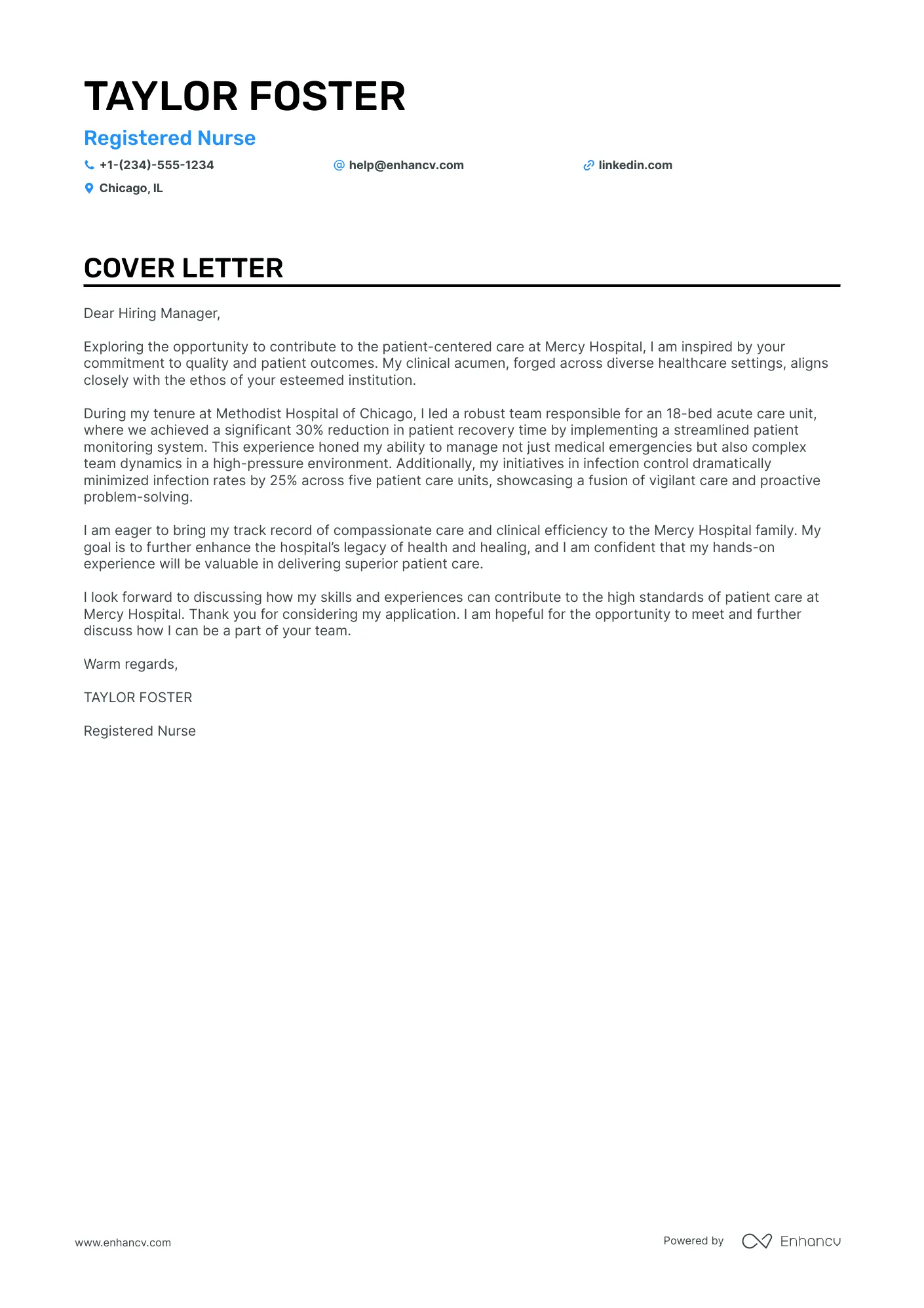
What is a Nursing Cover Letter?
A nursing cover letter is a crucial document accompanying your resume when applying for nursing positions. It serves as your introduction to a potential employer, providing a personalized overview of your qualifications, skills, and experience. Unlike a resume, which provides a factual account, a cover letter allows you to express your personality, demonstrate your enthusiasm for the role, and highlight why you’re the perfect fit for the specific nursing opportunity. It’s your chance to showcase your passion for patient care and your understanding of the healthcare environment. A well-crafted nursing cover letter can significantly increase your chances of landing an interview and ultimately securing your dream nursing job.
Why is a Nursing Cover Letter Important?
In a competitive field like nursing, a cover letter provides a unique opportunity to distinguish yourself from other applicants. It allows you to go beyond the bullet points of your resume and offer a deeper understanding of your qualifications. By showcasing your relevant skills, experiences, and personality, you demonstrate your suitability for the role and the organization’s values. Furthermore, it allows you to address any potential gaps in your resume, such as career changes or periods of unemployment. A strong cover letter reveals your commitment, attention to detail, and ability to communicate effectively, all essential qualities for a successful nurse. The ability to clearly articulate your strengths and aspirations can significantly impact the hiring manager’s decision-making process.
Key Components of a Nursing Cover Letter

A well-structured nursing cover letter comprises several key components, each playing a vital role in effectively communicating your qualifications. These elements work together to present a compelling case for why you are the ideal candidate. Each section should be tailored to the specific job description and the organization’s values. Careful attention to each component will ensure your cover letter stands out. Remember to focus on what you can offer the employer and how your skills align with their needs. The key is to demonstrate how you can contribute to the team and provide excellent patient care.
Header Section
The header section of your nursing cover letter includes your contact information, the date, and the hiring manager’s details. This section establishes your professionalism and makes it easy for the employer to contact you. Ensuring accuracy and completeness in this section demonstrates your attention to detail. The correct formatting is crucial for a polished and professional appearance.
Your Contact Information
Include your full name, address, phone number, and professional email address. Make sure your email address sounds professional. Double-check all information for accuracy.
Date

Place the current date directly below your contact information. Use a standard format (e.g., Month, Day, Year).
Hiring Manager’s Information
If possible, address the cover letter to a specific person (the hiring manager or recruiter). Find their name on the job posting or the company’s website. Use their full name and title. If you can’t find a name, use a general salutation such as “Dear Hiring Manager” or “Dear [Department Name] Hiring Team”.
Salutation
Begin your cover letter with a professional salutation. “Dear Mr./Ms./Mx. [Last Name]” is the best option if you know the hiring manager’s name. If you don’t know the name, use “Dear Hiring Manager” or a similar greeting. Avoid generic salutations like “To Whom It May Concern,” as they can make your letter seem impersonal.
Body Section

The body of your nursing cover letter is the core of your message, where you explain your qualifications and express your interest in the position. It should consist of three to four paragraphs, each with a specific purpose. The body needs to show you understand the requirements of the role and how your skills and experience align with them. Each paragraph should be concise, well-written, and tailored to the specific job and organization.
First Paragraph Introduction
Start with a strong opening that immediately grabs the reader’s attention. State the position you are applying for and where you found the job posting. Briefly express your enthusiasm for the opportunity and the organization. Mention any key skills or experiences that align directly with the job requirements. The first paragraph should be clear and to the point, creating a positive impression from the start.
Expressing Interest
Show your genuine interest in the position and the organization. Research the hospital or healthcare facility to demonstrate your understanding of their mission and values. Mention specific aspects of the role or the organization that excite you. Show why you are a great fit for their specific environment.
Highlighting Key Skills and Experiences

In the second paragraph, highlight your most relevant skills and experiences. Refer to the job description and identify the key requirements. Provide concrete examples of how you have demonstrated these skills in past roles. Use the STAR method (Situation, Task, Action, Result) to describe your accomplishments. Quantify your achievements whenever possible, such as reducing patient wait times or improving patient satisfaction scores. Tailor your content to the specific requirements of the role. Keep the focus on providing value to the employer.
Second Paragraph Detailing Skills and Experience
This paragraph is your opportunity to elaborate on your key skills and experiences, providing more detailed examples. Instead of simply listing your skills, describe how you have used them to achieve positive outcomes in previous roles. For example, if the job description emphasizes patient communication, describe a specific situation where you successfully communicated with a patient or their family. Focus on the impact of your actions and the positive results you achieved. Use action verbs to describe your contributions. The more specific you are, the more compelling your application will be. Demonstrate the value you brought to your previous roles, showing how you can replicate these results.
Quantifiable Achievements
Whenever possible, quantify your accomplishments. Use numbers and statistics to illustrate your impact. For example, instead of saying you improved patient care, state that you “decreased patient falls by 15%” or “increased patient satisfaction scores by 10%.” Quantifiable achievements demonstrate your effectiveness and provide concrete evidence of your abilities. Using data reinforces your claims. Include any metrics or data points that showcase your contributions. Using numbers helps the hiring manager immediately understand your impact.
Third Paragraph Explaining Fit

In the third paragraph, explain why you are a good fit for the organization’s culture and values. Research the organization’s mission, values, and culture. Explain how your personal values align with theirs. Describe how your experience and skills make you a great fit for their team. This shows that you have done your research and are genuinely interested in joining their team. Show that you understand the organization’s goals and how you can help them achieve them.
Cultural Fit and Values
Discuss your understanding of the organization’s values and how your work ethic aligns with their mission. Highlight any relevant values, such as teamwork, patient-centered care, or innovation. Describe how you have demonstrated these values in your previous roles. Showing that you align with the organization’s values is crucial. This section should demonstrate that you are a good match for their environment and are committed to their goals. Align your skills and experiences with the organization’s values.
Call to Action
Conclude your cover letter with a clear call to action. Express your interest in an interview and state how you can be contacted. Thank the hiring manager for their time and consideration. Reiterate your enthusiasm for the opportunity. End with a professional and positive tone. Your closing should invite the hiring manager to take the next step. Make it easy for them to contact you.
Closing Section

The closing section of your nursing cover letter includes your complimentary close and your signature. This reinforces your professionalism and leaves a lasting positive impression.
Complimentary Close
Use a professional closing such as “Sincerely,” “Best regards,” or “Thank you.” Make sure the closing aligns with the tone of your cover letter. Avoid informal closings. Choose a professional and appropriate closing.
Signature
Type your full name below your complimentary close. If you are submitting a printed cover letter, leave space for your handwritten signature above your typed name. A handwritten signature adds a personal touch to your cover letter and demonstrates your attention to detail.
Proofreading and Formatting
Before submitting your cover letter, carefully proofread it for any errors in grammar, spelling, and punctuation. Ensure the formatting is consistent and professional. A polished cover letter demonstrates your professionalism and attention to detail, increasing your chances of success. Have someone else review your cover letter. Make sure your cover letter is easy to read. Avoid using overly complex language. Use a standard font and size for the best readability.
Cover Letter Examples and Templates
Utilize cover letter examples and templates to guide you in crafting your own. Search online for examples specifically tailored to nursing roles. Tailor the template to your qualifications. Remember to customize the template to reflect your unique skills and experiences. These can provide a good starting point and assist you in structuring your cover letter. Always personalize the examples to reflect your experiences.
Adapting Your Cover Letter for Different Nursing Roles
Nursing roles vary, so tailor your cover letter to the specific position you are applying for. Highlight the skills and experiences most relevant to the job description. Be sure to modify the cover letter to match the requirements of the role. Take the time to review and amend your cover letter. Your cover letter should reflect your specific experience and match the role being offered.
Registered Nurse (RN) Cover Letter
Focus on your clinical skills, patient care experience, and any special certifications or specializations. Highlight your ability to manage patient care plans, administer medications, and collaborate with other healthcare professionals. If the role is in a specific area, such as intensive care or pediatrics, emphasize any relevant experience and skills. Mention any skills or experience related to leadership or teamwork. If applicable, talk about experiences with electronic health records (EHRs).
Licensed Practical Nurse (LPN) Cover Letter
Emphasize your experience in providing direct patient care, assisting with medical procedures, and monitoring patient health. Highlight your ability to follow instructions, communicate effectively with patients and their families, and work as part of a team. Include any skills related to medication administration, wound care, or other specialized tasks. If you have leadership skills, mention them. Show your ability to provide compassionate and empathetic care.
Nurse Practitioner (NP) Cover Letter
Highlight your advanced clinical skills, ability to diagnose and treat patients, and experience in providing comprehensive healthcare services. Mention any specializations or areas of expertise, such as family practice, cardiology, or geriatrics. Describe your experience in ordering and interpreting diagnostic tests, prescribing medications, and collaborating with physicians and other healthcare professionals. Include any skills or experiences related to patient education and health promotion. Mention any leadership and management skills you have.
Common Mistakes to Avoid in Your Cover Letter
Avoid common mistakes, such as typos, grammatical errors, and generic language. Make sure the formatting is clean and easy to read. Do not submit a generic cover letter that is not tailored to the specific job. Avoid using jargon or overly complex language. Ensure that your cover letter is the appropriate length (ideally, one page). Do not repeat the content of your resume verbatim. Avoid negative language or criticizing past employers.