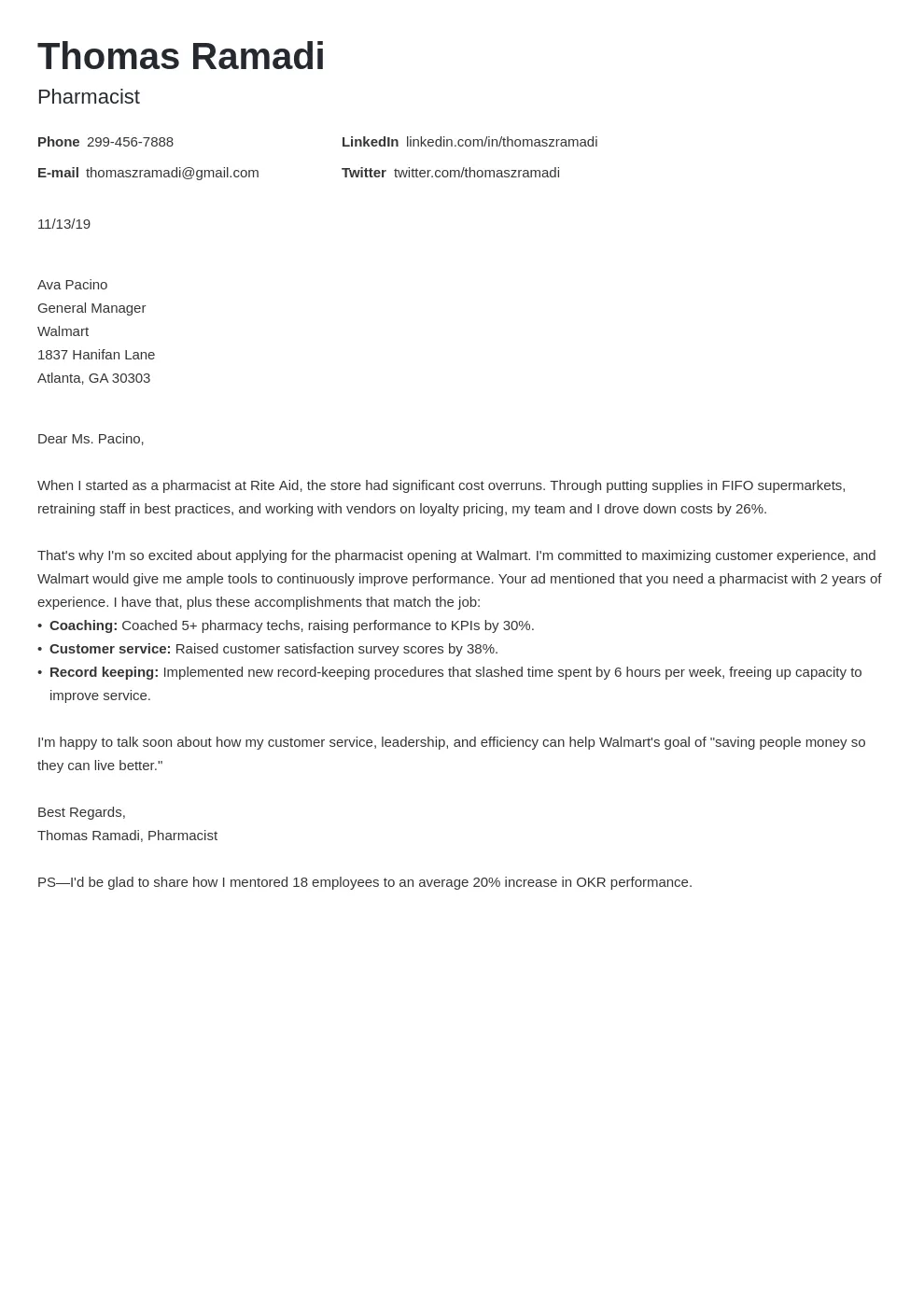
Understanding the Importance of a Pharmacist Cover Letter
A pharmacist cover letter is more than just a formality; it’s your first opportunity to make a strong impression on a potential employer. While your resume provides a factual overview of your qualifications, your cover letter allows you to showcase your personality, passion, and suitability for the specific role. It serves as a crucial tool in highlighting your key skills, experiences, and achievements, while also demonstrating your understanding of the company and the position. This guide will help you navigate the process of crafting a compelling cover letter that effectively communicates your value as a pharmacist and increases your chances of landing an interview. It is your chance to stand out from a pile of applications, making a memorable pitch of your experience and goals.
Why a Strong Cover Letter Matters
In the competitive field of pharmacy, a well-written cover letter can be the deciding factor between getting an interview and being overlooked. It provides context to your resume, allowing you to elaborate on experiences and skills that directly align with the job requirements. Recruiters and hiring managers often use cover letters to assess your communication skills, attention to detail, and genuine interest in the position and the company. A strong cover letter demonstrates your professionalism, your ability to articulate your career goals, and your understanding of what the employer is looking for. It’s an opportunity to tell your story and explain why you are the best candidate. Furthermore, it lets you show your understanding of the company’s mission, values, and how you can contribute to their success. The cover letter is, in essence, your personal sales pitch, highlighting your key strengths and what you can bring to the table.
Key Components to Include in Your Cover Letter

Crafting a compelling pharmacist cover letter involves including several key components to ensure it is comprehensive and impactful. Each part serves a specific purpose in conveying your qualifications and enthusiasm. The following sections will guide you in creating a cover letter that captures attention and leaves a lasting positive impression on potential employers. Following the correct format and including all the necessary details will make your cover letter a strong asset in your job application.
Contact Information and Salutation
Start your cover letter with your contact information, including your full name, address, phone number, and professional email address. Then, address the hiring manager by name if possible. Research the company to find out the name of the person who will be reviewing your application and address them accordingly. Using a direct salutation makes your cover letter more personal and demonstrates your attention to detail and initiative. This initial step sets a tone of professionalism and shows your commitment to the role. If you are unable to find the hiring manager’s name, use a professional greeting, like ‘Dear Hiring Manager’ to ensure a formal tone.
Highlighting Your Skills and Qualifications
In the body of your cover letter, clearly state your skills and qualifications. Focus on the most relevant abilities for the specific job you are applying for. Include examples of how you have used these skills to achieve positive outcomes. Use keywords from the job description to show that you meet the employer’s needs. When highlighting your skills, be specific and provide measurable results whenever possible. This could include reducing medication errors, improving patient outcomes, or increasing pharmacy efficiency. Showcase not only your technical expertise but also your soft skills, such as communication, teamwork, and problem-solving. Tailor this section to each job application to make it more effective.
Education and Certifications Section

Provide details of your pharmacy education, including your degree (e.g., PharmD), the name of the institution, and the year of graduation. Mention any relevant certifications or licenses, such as your state pharmacy license and any specializations you hold (e.g., Board Certified Pharmacotherapy Specialist). Ensure that your certifications are up-to-date and relevant to the job. If you have completed any postgraduate training, like a residency program, be sure to include it as it will provide additional value to your application. Mention any academic achievements, awards, or honors that showcase your accomplishments. This section is critical for showing your foundational knowledge and your commitment to the profession.
Work Experience Section
Detail your previous work experience, including the name of the pharmacy or healthcare facility, your job title, and the dates of employment. For each position, describe your responsibilities and achievements. Focus on the experiences that are most relevant to the job you are applying for. Use action verbs to describe your accomplishments, and quantify your achievements whenever possible. For example, ‘Reduced medication errors by 15%’ or ‘Managed a team of five pharmacy technicians’. Highlighting the successful outcomes that you generated in past roles demonstrates your ability to deliver and achieve results. Tailor the information for the job application to draw connections between your experience and the requirements.
Quantifying Your Achievements
Whenever possible, quantify your achievements to demonstrate the impact you made in your previous roles. Use numbers, percentages, and specific data to illustrate your accomplishments. Instead of saying ‘Improved patient care,’ state ‘Improved patient adherence to medication by 20% through patient counseling.’ By quantifying your achievements, you provide concrete evidence of your capabilities and make a stronger impression on the hiring manager. Using data to showcase your success helps to show your ability to use analysis to improve processes. Consider including metrics like customer satisfaction scores, inventory management improvements, or cost savings achieved. These specific details will help you to stand out in the selection process.
Expressing Your Enthusiasm and Interest

Convey your enthusiasm for the specific job and the company in your cover letter. Explain why you are interested in the position and what attracts you to the organization. Mention any aspects of the company’s mission, values, or culture that resonate with you. Demonstrate your knowledge of the company by mentioning specific initiatives, programs, or services that interest you. Expressing genuine interest can show that you are not simply looking for any job, but that you are genuinely excited about the opportunity. Your interest demonstrates your personal investment in the opportunity.
Tailoring Your Cover Letter to the Specific Job
Customize each cover letter to the specific job you are applying for. Do not send a generic cover letter for multiple applications. Carefully review the job description and tailor your cover letter to highlight the skills and experiences that are most relevant to the position. Use keywords from the job description throughout your cover letter to show that you meet the employer’s needs. Customize the introduction and conclusion to mention why you are interested in that particular company and role. Tailoring your cover letter demonstrates your attention to detail, your genuine interest, and your ability to understand and meet the requirements of the role. A personalized cover letter shows a stronger connection to the employer’s needs.
Formatting and Proofreading Your Cover Letter
Formatting and proofreading are essential to ensure your cover letter is professional and error-free. Poorly formatted and uncorrected cover letters can reflect negatively on your attention to detail and your communication skills. By paying close attention to formatting and proofreading, you can ensure your cover letter makes a positive and lasting impression. Be certain to read the document at least twice before submitting your application.
Font and Style Guidelines

Choose a professional and easy-to-read font, such as Times New Roman, Arial, or Calibri. The font size should be between 10 and 12 points. Use single-spacing within paragraphs and double-spacing between paragraphs. Use clear headings and subheadings to break up the text and make it easier to read. Maintain consistent formatting throughout the document. Proper formatting is important to highlight the professionalism in your presentation, show organization, and show that you are a detail-oriented person. Ensure that the layout is clean and easy to follow, with ample white space for readability. These formatting principles ensure that your cover letter looks neat, organized, and is easy to read.
Proofreading for Errors
Thoroughly proofread your cover letter for any spelling, grammar, or punctuation errors. Errors can undermine your credibility and make a negative impression on the hiring manager. Use spell-check and grammar-check tools, but also read your cover letter carefully to catch any errors those tools might miss. Ask a friend or family member to review your cover letter to ensure it is free of errors. Proofreading will help to make your application stronger. Ensure that your cover letter is perfect before submitting it, as this is the first impression you are making. An error-free cover letter shows your attention to detail and professionalism.
Cover Letter Examples for Pharmacists
Reviewing cover letter examples can help you understand the structure, content, and style of an effective cover letter. Examples provide a template for you to build upon, giving you a starting point to tailor your cover letter. By studying various cover letter examples, you will be able to see what information is usually included in different situations. Different types of jobs require specific information to be included. The following examples will give you some of the best templates and information to help you with your application.
Entry-Level Pharmacist Cover Letter Example

An entry-level pharmacist cover letter should highlight your education, any internships or rotations, and your eagerness to learn and contribute. Focus on any relevant coursework, skills you gained during your pharmacy school, and your potential to learn and grow within the company. Show that you are enthusiastic and ready to apply your knowledge. Demonstrate your understanding of pharmacy practice and your commitment to providing excellent patient care. This cover letter example focuses on your academic achievements and practical training. Emphasize your skills and qualifications, even without extensive work experience. Mention any awards, research projects, or volunteer work that demonstrate your dedication.
Experienced Pharmacist Cover Letter Example
For experienced pharmacists, the cover letter should emphasize your professional achievements, such as any leadership roles, and the impact you had on previous employers. Quantify your accomplishments whenever possible, for example, ‘Reduced medication errors by 15%.’ Highlight any specialized skills, such as experience in a particular pharmacy setting (e.g., hospital, retail, compounding). Showcase your ability to handle complex medication therapy management, patient counseling, and leadership responsibilities. Demonstrate your ability to lead a team, mentor junior pharmacists, and contribute to the pharmacy’s overall success. Focus on your achievements and the value that you will bring to the new organization.
Pharmacist Technician Cover Letter Example
A pharmacist technician cover letter should highlight relevant skills and experience, such as dispensing medications, inventory management, and customer service. Mention any certifications you have, like a pharmacy technician certification. Focus on your attention to detail, accuracy, and ability to work under pressure. Show your ability to assist pharmacists and ensure smooth pharmacy operations. Detail your relevant experience in handling prescriptions, managing inventory, and assisting with patient care. Illustrate your commitment to maintaining accurate records and providing great customer service. Express your ability to follow instructions, adhere to pharmacy protocols, and contribute to a positive work environment.
Cover Letter Writing Tips and Best Practices

To create a successful cover letter, you should keep the best practices in mind. The better your writing quality is, the more chances you have of getting the job. In order to impress the hiring manager, you should be able to provide useful information using the best communication skills. These tips will help you optimize your writing skills.
Keywords to Use in Your Cover Letter
Use keywords from the job description throughout your cover letter. This helps demonstrate that you meet the employer’s needs and increases the chances of your application being selected by Applicant Tracking Systems (ATS). Common keywords for pharmacists include ‘medication therapy management,’ ‘patient counseling,’ ‘pharmacy operations,’ ‘inventory management,’ ‘prescription dispensing,’ ‘clinical pharmacy,’ ‘pharmacy software,’ and specific skills or technologies mentioned in the job posting. Including the job description keywords is important, so carefully analyze it before creating your cover letter. Use the job description as your guide to tailor the content and make sure you are including the most important requirements.
Dos and Don’ts of Cover Letter Writing
Follow some key guidelines to make your cover letter strong, and avoid common mistakes. When writing a cover letter, focus on what you can do for the company. Always highlight your skills, qualifications, and what you can bring to the table. Provide specific examples to prove your skills. Do not make grammatical errors. Ensure you have all the relevant contact information. Also, tailor the cover letter to the job. Avoid generic phrases and clichés, such as ‘hard worker’ or ’team player’. Do not simply repeat your resume; instead, provide additional context and insights. Always avoid negative comments about previous employers. Keep your writing concise and professional, as the hiring manager will be reading many applications.
Finalizing and Submitting Your Cover Letter
Once you have written and edited your cover letter, you need to make sure that you are ready to submit it. Ensuring you do not miss any key details is essential for a successful application. Before submitting, it is always a good idea to have another person review the cover letter to catch errors. By following these steps, you will have the best chance of creating a successful cover letter.
Reviewing and Refining Your Cover Letter
Before submitting your cover letter, review it carefully to make sure it’s perfect. Check for any errors in grammar, spelling, and punctuation. Ensure that your formatting is consistent and professional. Make sure your contact information is accurate. Verify that the cover letter is tailored to the specific job and company. Refine your language to ensure it is clear and concise, and avoid any jargon. Ask a friend, family member, or career advisor to review your cover letter and provide feedback. Making these refinements will help you to create the best impression.
Submitting Your Application
Follow the application instructions provided by the employer. If the job posting specifies a format for submitting your cover letter and resume, adhere to it. Generally, you will submit your cover letter as an attachment to your application. Ensure your cover letter is saved in a professional format, such as PDF, to preserve the formatting. Double-check that you have included all necessary documents, such as your resume, and any other required materials. Make sure you send the email to the correct address. After submitting your application, consider following up with a polite email or phone call to express your continued interest in the role. This shows your initiative, interest, and dedication.