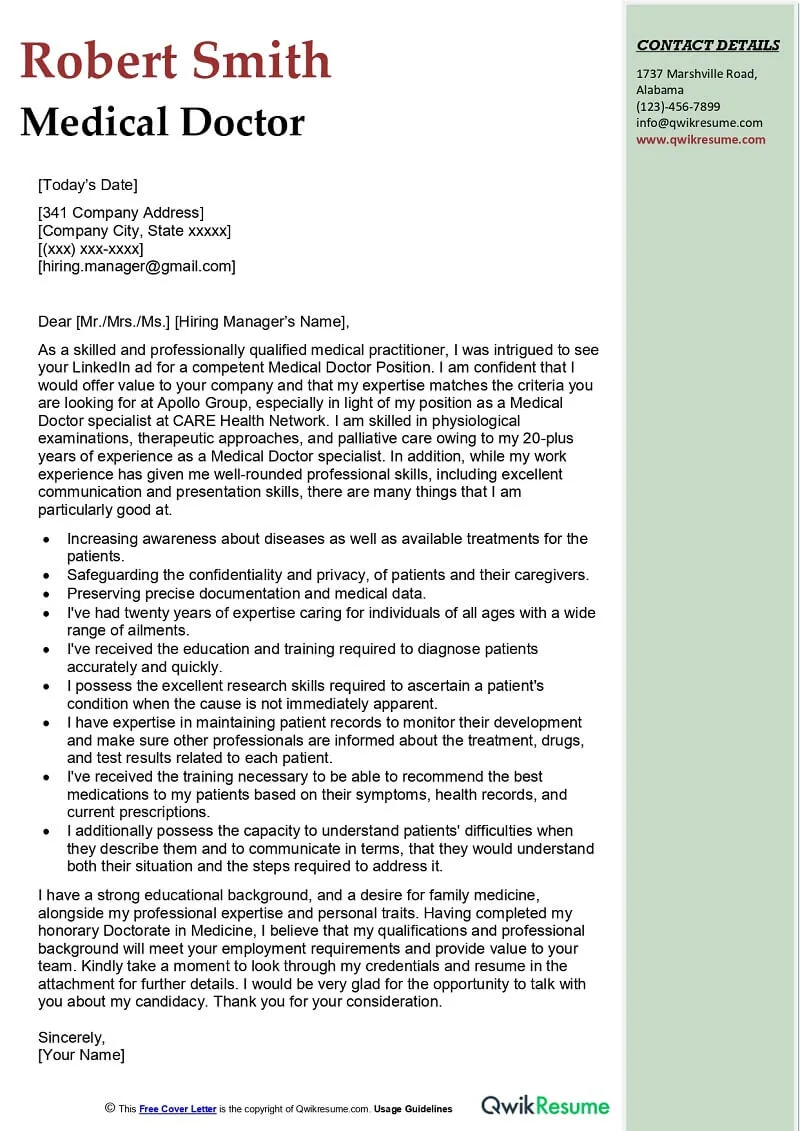
What is a Medical Cover Letter
A medical cover letter is a crucial document that accompanies your resume when applying for medical jobs. It serves as your introduction to the hiring manager, providing an opportunity to highlight your qualifications, skills, and experiences relevant to the specific position. Unlike a resume, which provides a factual overview of your professional history, a cover letter allows you to showcase your personality, express your enthusiasm for the role, and explain why you are the ideal candidate. A well-crafted medical cover letter can significantly increase your chances of landing an interview and ultimately securing your desired job. Think of it as your first impression and a chance to make a compelling case for your candidacy.
Key Components of a Medical Cover Letter
A strong medical cover letter is composed of several key elements that work together to create a persuasive and professional presentation. These components ensure that your letter is well-organized, informative, and tailored to the specific job you are applying for. Each element plays a critical role in conveying your suitability for the position and demonstrating your understanding of the role and the healthcare environment. The following sections detail the essential parts of a medical cover letter, providing guidance on what to include and how to present your information effectively. This will help you create a cover letter that stands out.
Contact Information

Begin your cover letter with your contact information, including your full name, address, phone number, and email address. This should be placed at the top of the letter, typically left-aligned. Ensure that your contact information is accurate and up-to-date. It’s important that the hiring manager can easily reach you if they want to schedule an interview. This section provides a quick and easy way for the recipient to know how to get in touch with you.
Professional Header
Following your contact information, include the date and the hiring manager’s contact information. If you know the name of the hiring manager, address the letter to them directly (e.g., “Dear Dr. Smith”). Otherwise, you can use a general salutation (e.g., “Dear Hiring Manager”). This level of personalization shows that you have taken the time to research the company and the specific role. Proper formatting with a professional header gives the letter a polished and professional appearance, increasing its impact. Use a professional font such as Times New Roman or Arial.
Body Paragraphs
The body paragraphs are the heart of your cover letter. They allow you to elaborate on your skills, experiences, and qualifications in relation to the job requirements. The body of your letter should be concise, engaging, and tailored to the specific position. The goal is to capture the reader’s attention and encourage them to read your entire letter. Structure your body paragraphs in a way that highlights your relevant experiences and showcases your personality. The body of a medical cover letter typically consists of three main paragraphs, each with a specific purpose.
First Paragraph

Start your first paragraph by stating the position you are applying for and where you found the job posting. Briefly mention why you are interested in the role and the company. This should grab the reader’s attention and provide them with a clear understanding of your objective. Your opening should be concise, enthusiastic, and show a genuine interest in the opportunity. Expressing your enthusiasm sets the tone for the rest of the letter and encourages the reader to continue. Make a strong first impression by clearly stating your purpose for writing and what interests you about the role and the organization.
Second Paragraph
The second paragraph should highlight your key qualifications, skills, and experiences that align with the job requirements. This is where you demonstrate your value to the employer. Provide specific examples of how you have used your skills in previous roles and the results you achieved. Refer to the job description to understand the required skills and tailor your response accordingly. Quantify your accomplishments whenever possible to demonstrate your impact. For instance, if you improved patient satisfaction scores, include the percentage or the number of patients positively impacted. Use this section to showcase your relevant skills, training, and experiences to show how you are the right fit.
Third Paragraph
Use the third paragraph to express your interest in the company and the role, reiterating why you are a good fit. Discuss what attracts you to the company culture or mission, and what you hope to achieve in this role. This is your opportunity to show that you have researched the company and that you are genuinely interested in joining their team. This also allows you to explain your career goals and how this position aligns with those goals. Summarize your key qualifications and reiterate your enthusiasm for the opportunity, inviting the employer to consider your application.
Closing Paragraph

The closing paragraph should summarize your interest in the position and thank the hiring manager for their time and consideration. Express your eagerness to discuss your qualifications further and reiterate your contact information. Make sure you are clear about your availability for an interview, and state that you look forward to hearing from them. This is your final chance to leave a positive impression. End your cover letter with a professional closing to reinforce your enthusiasm and reiterate your interest in the position. Make sure that you thank the person for their time.
Formal Closing
Close your letter with a professional closing such as “Sincerely,” “Respectfully,” or “Best regards,” followed by your typed name. If you are sending a physical copy, leave space for your signature above your typed name. Ensure your signature is clear and legible. A professional closing ensures that your cover letter is complete and reflects your professionalism. This is the final touch that presents your attention to detail and respect for the recipient. Proper formatting and a professional closing help create a positive impression. Use your full name and avoid abbreviations.
How to Tailor Your Medical Cover Letter
Customizing your medical cover letter for each job application is essential for demonstrating your genuine interest and showcasing your relevant skills. A generic cover letter does not resonate with employers. Tailoring your letter shows that you have taken the time to understand the specific requirements of the position and the needs of the hiring organization. Customizing your cover letter increases your chances of getting an interview by demonstrating that you are a strong candidate. Tailor your letter to demonstrate that you meet the specific criteria listed in the job posting.
Researching the Employer

Before writing your cover letter, research the employer. Visit their website, read their mission statement, and learn about their values, services, and recent developments. Understand their organizational structure, the departments, and the specific roles. This will enable you to tailor your cover letter to the employer’s needs and demonstrate your understanding of their operations. This research will allow you to tailor your cover letter to highlight how your skills and experiences align with the employer’s needs. Demonstrating this knowledge will make your cover letter stand out. Use this information to address the specific needs of the employer and highlight your contributions.
Highlighting Relevant Skills and Experiences
Carefully review the job description and identify the key skills, experiences, and qualifications that the employer is seeking. Then, highlight your relevant skills and experiences. Use examples from your past roles, projects, or volunteer experiences to demonstrate how you have used these skills. Quantify your achievements whenever possible, using numbers or data to show your impact. For example, if you improved patient outcomes, state the percentage improvement or the specific results. This is important to demonstrate that you possess the necessary skills and can deliver results. Focus on what is most relevant to the job to show you are a good match.
Using Action Verbs
Use strong action verbs to describe your accomplishments and responsibilities. Action verbs create a dynamic and engaging cover letter. For example, instead of saying “Responsible for patient care,” say “Managed patient care effectively.” Examples of action verbs include “Managed,” “Trained,” “Developed,” “Implemented,” “Coordinated,” and “Improved”. These words provide a strong and compelling narrative, keeping the hiring manager engaged. Using action verbs paints a picture of your capabilities and makes your accomplishments more memorable. Using action verbs makes your cover letter more dynamic. Using action verbs in your writing creates a powerful impact.
Medical Cover Letter Mistakes to Avoid

To create a compelling medical cover letter, it is vital to avoid common mistakes that can undermine your application. These errors can make your letter appear unprofessional or unsuited for the role. Recognizing and avoiding these pitfalls will greatly enhance your chances of success. Being aware of these mistakes can help you avoid losing your chances. Avoiding these errors can help ensure you make a positive first impression.
Typos and Grammatical Errors
Typos and grammatical errors can make you appear careless and unprofessional. Always proofread your cover letter carefully before submitting it. Use spell-check and grammar-check tools, and consider having a friend or colleague review your letter for errors. Ensuring that your letter is error-free demonstrates your attention to detail and your respect for the hiring manager. A cover letter free of typos gives a polished and professional impression. These can be a distraction from the content of your cover letter. Always proofread your work.
Generic Content
Avoid using a generic cover letter that is not tailored to the specific job or employer. Generic letters do not show your genuine interest in the position. Each cover letter should be customized to reflect the unique requirements of the role and the values of the organization. Always tailor your cover letter to match the job description. Demonstrating that you have taken the time to research the role and the company will impress the hiring manager. Generic letters show a lack of interest. Taking the time to personalize your cover letter will significantly improve your chances of success.
Lack of Enthusiasm

A cover letter should showcase your enthusiasm for the role and the company. Avoid sounding indifferent or uninspired. Use strong, positive language to express your interest and excitement about the opportunity. Show the hiring manager that you genuinely want the job. Expressing enthusiasm makes you sound more appealing and shows that you are motivated. Showing enthusiasm is important in your cover letter, as it can make you stand out from other applicants. Showing enthusiasm through your words can demonstrate how passionate you are about the role.
Medical Cover Letter Examples
Reviewing medical cover letter examples can give you a better understanding of how to structure and write your own letter. Examples provide inspiration and guidance. Understanding the examples will help you write a professional cover letter that meets the hiring manager’s expectations. These examples help you to learn how to properly format a cover letter and how to approach the tone. Looking at examples provides ideas for how to present your skills and experience. The goal is to provide you with guidance on creating a medical cover letter.
Example 1
This example shows how to structure a cover letter for a Physician Assistant position. It demonstrates the key skills needed for the role and shows how to highlight the applicants’ qualifications. The key skills and qualifications should be relevant to the job description. The goal is to make sure that your letter is tailored to the role and is engaging. By following the format, you can ensure that your cover letter meets the expectations of the hiring manager and stands out from other applicants.
Example 2
This example focuses on creating a cover letter for a Registered Nurse (RN) position. It shows how to present your previous experience in a clear, concise, and professional manner. This example emphasizes how to show enthusiasm for the position. Highlighting relevant experiences and skills shows the hiring manager that you are a strong candidate. Be sure to read through this example to see how to make your application stand out.
Tips for Formatting your Medical Cover Letter
The format of your medical cover letter is essential for making a professional first impression. Formatting is the first thing a hiring manager will see. Proper formatting enhances readability and presents your application as polished and organized. The formatting choices you make can greatly affect the overall impact of your cover letter. Formatting affects how easy it is to read your letter. Proper formatting is a good way to make a positive impression on the person.
Font and Font Size
Choose a professional and easy-to-read font such as Times New Roman, Arial, or Calibri. Use a font size between 10 and 12 points. Avoid using overly stylized fonts that may be difficult to read. Maintain consistency throughout the document. Correct font choice presents you as professional. This will ensure your cover letter is readable and professional. Your font choice needs to make your cover letter easier to read.
Margins and Spacing
Set your margins to 1 inch on all sides to ensure your letter is well-balanced and easy on the eyes. Use single-spacing within paragraphs and double-spacing between paragraphs. Proper spacing makes the document easier to read and helps the hiring manager to quickly grasp your key points. These formatting options improve readability and organization. Correct spacing will improve the appearance of your letter. Ensuring your formatting creates a professional look for your application.