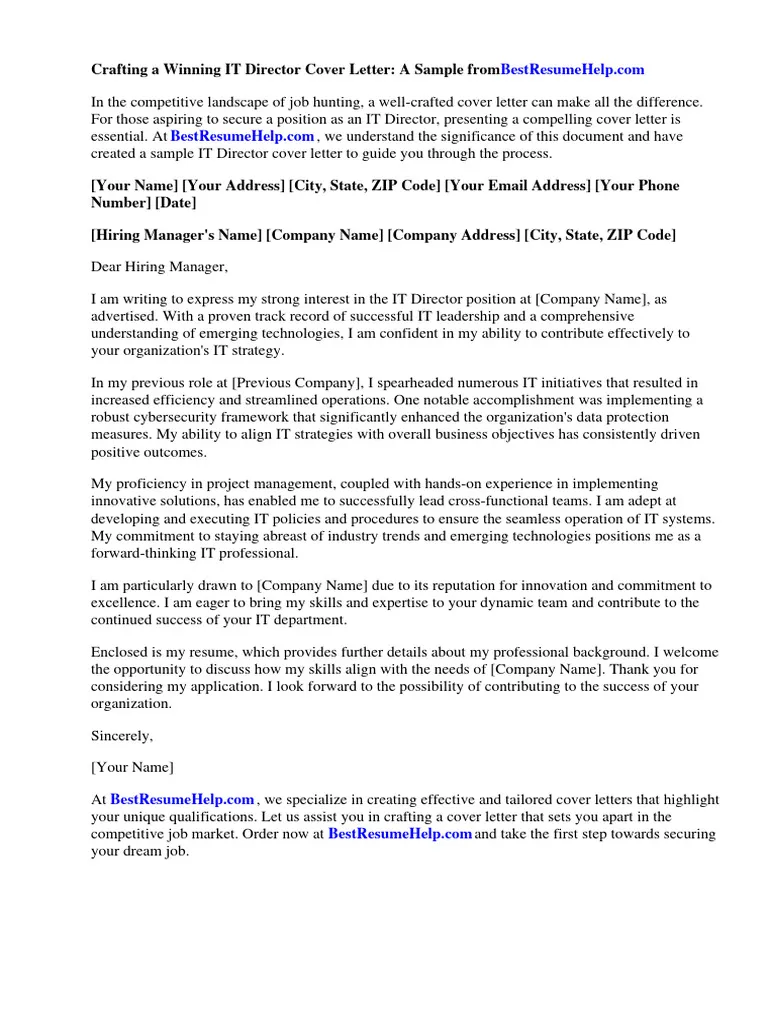
Crafting the Perfect IT Director Cover Letter
Landing an IT Director position requires more than just a stellar resume. A well-crafted cover letter is your opportunity to make a strong first impression, showcasing your skills, experience, and enthusiasm for the role. It’s your chance to go beyond the bullet points and demonstrate your personality and how you fit into the company culture. This guide will provide you with the secrets to writing a cover letter that grabs attention and gets you noticed by hiring managers. We’ll break down the essential elements, formatting tips, and common pitfalls to avoid, ensuring your application stands out from the competition. Use this knowledge to showcase why you are the best candidate for the job.
Understanding the Role of an IT Director
Before you even begin to write your cover letter, you need a firm grasp of what an IT Director does. This understanding will inform the language you use, the skills you highlight, and the overall tone of your letter. IT Directors are strategic leaders responsible for the overall technology direction of an organization. They align IT strategies with business goals, manage IT budgets, oversee IT infrastructure, and lead IT teams. They must possess a blend of technical expertise, leadership skills, and business acumen. Your cover letter must reflect this multifaceted role.
Key Responsibilities of an IT Director

IT Directors wear many hats. The job demands expertise in diverse areas. To effectively address them in your cover letter, you must understand these aspects. These include strategic planning, budget management, infrastructure oversight, team leadership, vendor management, risk management, and ensuring cybersecurity. Demonstrating experience in these areas is crucial. The most successful IT Directors are also excellent communicators. They convey technical information to non-technical audiences. They also build relationships across departments and with external stakeholders. Your cover letter should highlight your ability to excel in all of these critical responsibilities.
Essential Elements of a Cover Letter for IT Directors
Your IT Director cover letter is your introduction. It should be clear, concise, and compelling. Each element plays a crucial role in showcasing your qualifications and securing an interview. From the initial contact information to the closing statement, every word counts. By carefully including key components, you increase your chances of making a positive impression. This section will provide you with the guidance needed to write a winning cover letter. Ensure you include all the essential elements.
Contact Information and Salutation
Start with your contact information: name, phone number, email address, and LinkedIn profile URL (if you have one). Then, address the hiring manager by name. Research the company website or LinkedIn to find the name of the person responsible for hiring. If you cannot find a specific name, use a professional salutation like “Dear Hiring Manager”. Avoid generic greetings such as “To Whom It May Concern”, which can make your letter seem impersonal. It is essential to build a personal connection from the start, demonstrating your attention to detail and initiative.
Opening Paragraph — Hooking the Reader

The opening paragraph is your first and best opportunity to grab the reader’s attention. State the position you are applying for, how you learned about the opportunity, and a brief, compelling statement about why you are the ideal candidate. Avoid generic opening lines. Instead, try to inject some personality and demonstrate your enthusiasm for the role and the company. You might reference something specific that drew you to the position or mention a recent accomplishment that aligns with the company’s needs. The goal is to immediately capture the reader’s interest and make them want to read more.
Highlighting Relevant Skills and Experience
The body of your cover letter is where you elaborate on your skills and experience. Focus on the key requirements mentioned in the job description and use them as a framework for showcasing your qualifications. Provide specific examples of your accomplishments, such as successful projects you led, problems you solved, or improvements you implemented. Quantify your achievements whenever possible (see below), and use keywords from the job posting to demonstrate that you are a good fit. Emphasize the relevance of your skills and experience to the company’s needs, demonstrating that you are not just qualified but an ideal match.
Quantifying Achievements and Results
Using data to support your claims adds credibility and impact to your cover letter. Provide specific numbers, percentages, and dollar amounts to quantify your achievements. For example, instead of saying “Improved IT efficiency,” say “Increased IT efficiency by 20% through the implementation of a new cloud-based system, resulting in $50,000 in annual cost savings.” Quantifiable results show that you are results-oriented and understand how your work impacts the bottom line. This makes your accomplishments more tangible and impressive to the hiring manager.
Demonstrating Leadership and Management Abilities

IT Director roles require strong leadership and management skills. Your cover letter should demonstrate your ability to lead and motivate teams, manage projects, and make strategic decisions. Describe your experience leading teams, managing budgets, and overseeing IT infrastructure. Mention any leadership training or certifications you have. Use examples that showcase your ability to solve problems, drive innovation, and achieve organizational goals. It’s crucial to demonstrate that you can effectively manage both people and technical resources.
Showcasing Technical Expertise
While leadership skills are important, an IT Director must also possess a strong technical foundation. Highlight your technical expertise, mentioning specific technologies, systems, and platforms you have experience with. Tailor your technical skills to the job description. If the job requires experience with cloud computing, emphasize your experience with AWS, Azure, or Google Cloud. If cybersecurity is a priority, mention your certifications and experience with security protocols and tools. Tailoring this to the specific job will showcase that you have what the company needs.
Expressing Enthusiasm and Interest
Show genuine enthusiasm for the company and the position. Explain why you are interested in working for this particular organization. Mention something specific that attracts you to the company’s mission, values, or culture. Show you have researched the company and understand its goals. This demonstrates your genuine interest and your desire to contribute to their success. This also helps to set you apart from candidates who may be applying for multiple jobs.
Call to Action and Closing

End your cover letter with a clear call to action. Express your interest in an interview and thank the hiring manager for their time and consideration. Reiterate your contact information and provide your availability for an interview. Keep the closing professional and concise. This ensures you leave a positive impression and gives the hiring manager clear instructions on the next steps. A strong closing statement reinforces your interest and professionalism.
Formatting and Presentation Tips
The presentation of your cover letter is just as important as its content. A well-formatted cover letter shows that you pay attention to detail and can present information clearly and professionally. Poor formatting can detract from the message you are trying to convey, so it’s crucial to get this right. It’s all about first impressions. Your formatting shows how serious you are about getting the job.
Choosing the Right Font and Font Size
Choose a professional and easy-to-read font. Popular choices include Times New Roman, Arial, Calibri, and Helvetica. Use a font size between 10 and 12 points. This ensures that your cover letter is legible and looks professional. Avoid using overly decorative fonts or excessively large or small font sizes. Make sure the document is easy on the eyes, as the hiring manager may have to read many documents.
Using Proper Grammar and Spelling

Proofread your cover letter carefully for any grammatical errors or typos. Incorrect grammar and spelling errors can damage your credibility and make a negative impression. Use a grammar and spell-checking tool, but also read through your letter multiple times to catch any mistakes. Ask a friend or colleague to review your cover letter as well. Another set of eyes can often catch errors you might miss. Ensure your document is perfect and error-free.
Keeping it Concise and Focused
Keep your cover letter concise and focused. Aim for one page in length. Hiring managers are busy and may not have time to read lengthy cover letters. Focus on the most relevant information and avoid including unnecessary details. Use bullet points and clear headings to make the information easy to scan and digest. This improves readability and ensures that your key qualifications are immediately apparent. Brevity is key.
Tailoring the Cover Letter to the Job Description
A generic cover letter is unlikely to impress a hiring manager. Tailoring your cover letter to each job description demonstrates that you have taken the time to understand the specific requirements of the role and the needs of the company. This shows a genuine interest in the position and the organization. It’s vital to show you have paid attention to the company’s needs.
Researching the Company and Its Needs

Before writing your cover letter, research the company. Visit their website, read news articles, and check their social media profiles to understand their mission, values, and recent projects. This information will help you tailor your letter and demonstrate that you understand their needs. Identify the company’s current challenges or goals. This knowledge allows you to frame your skills and experience in a way that aligns with the company’s priorities. Show that you are interested in their specific organization.
Matching Skills and Experiences to Requirements
Carefully review the job description and identify the key skills and experiences the employer is seeking. Then, highlight how your skills and experiences match those requirements. Use the same keywords and phrases from the job description in your cover letter. Provide specific examples to illustrate how you have successfully applied those skills in the past. This demonstrates that you possess the qualifications the employer is looking for. Tailor your letter specifically to the company.
Customizing the Language and Tone
Adjust the language and tone of your cover letter to align with the company’s culture. If the company has a formal culture, use a professional and formal tone. If the culture is more casual, you can use a slightly more relaxed tone. Be mindful of the company’s industry and values. Research the company to help you tailor the language. If appropriate, inject some of your personality. This can make your cover letter more memorable. The goal is to sound like a good fit.
Common Mistakes to Avoid
Avoiding common mistakes can significantly improve your chances of success. Paying attention to these potential pitfalls can prevent you from making a negative impression on the hiring manager. It’s crucial to proofread, edit, and revise your cover letter to ensure it’s polished, professional, and error-free.
Generic or Irrelevant Information
Avoid using generic cover letters that could be sent to any company. Tailor your cover letter to each job application. Don’t include information that is irrelevant to the specific role or the company’s needs. Focus on the skills and experiences that directly align with the job requirements. Using generic language shows a lack of interest in the specific position. Always customize your cover letter to demonstrate your interest and suitability.
Typos and Grammatical Errors
As mentioned earlier, typos and grammatical errors can damage your credibility. Always proofread your cover letter carefully. Use grammar and spell-checking tools. Have a friend or colleague review your letter. Typos and grammatical errors demonstrate a lack of attention to detail. They can create a negative impression. Make sure your cover letter is perfect.
Lack of Quantifiable Results
Avoid vague statements. Always quantify your achievements. Instead of saying, “Improved efficiency,” say “Increased efficiency by 15% through the implementation of a new system.” Providing quantifiable results is essential. They show that you are results-oriented and understand how your work contributes to the bottom line. Adding data to your claims builds your credibility.
Ignoring the Company Culture
Research the company culture and tailor your cover letter to reflect its values and tone. Ignoring the company culture can make you seem like a poor fit. If the company has a formal culture, use a professional tone. If the culture is more casual, you can use a slightly more relaxed tone. Demonstrate that you understand and appreciate the company’s culture. This is essential for making a strong impression.
Reviewing and Polishing the Cover Letter
Before submitting your cover letter, take the time to review and polish it. This process will help you catch any errors, improve clarity, and ensure that your cover letter is as effective as possible. A final review can make a big difference.
Proofreading for Accuracy and Clarity
Carefully proofread your cover letter for any errors in grammar, spelling, and punctuation. Check the formatting to ensure that it is consistent and professional. Make sure your language is clear, concise, and easy to understand. Ask yourself if the letter is easy to read. The more you review, the better the final product will be.
Seeking Feedback from Others
Ask a friend, colleague, or career counselor to review your cover letter. They can provide an objective perspective and catch any errors or areas for improvement. Ask for feedback on the content, tone, and formatting. Their feedback can help you improve your cover letter and increase your chances of getting noticed. Take the time to have a fresh set of eyes look at your work.
Final Thoughts and Next Steps
Writing an effective IT Director cover letter is a critical step in your job search. By following the secrets outlined in this guide, you can create a cover letter that highlights your skills, experience, and enthusiasm for the role, and that makes a strong first impression on the hiring manager. Remember to tailor your letter to each job description. Proofread it carefully, and seek feedback from others. Good luck with your job search! With the right cover letter, you’ll be well on your way to landing your dream job. Now get out there and apply!