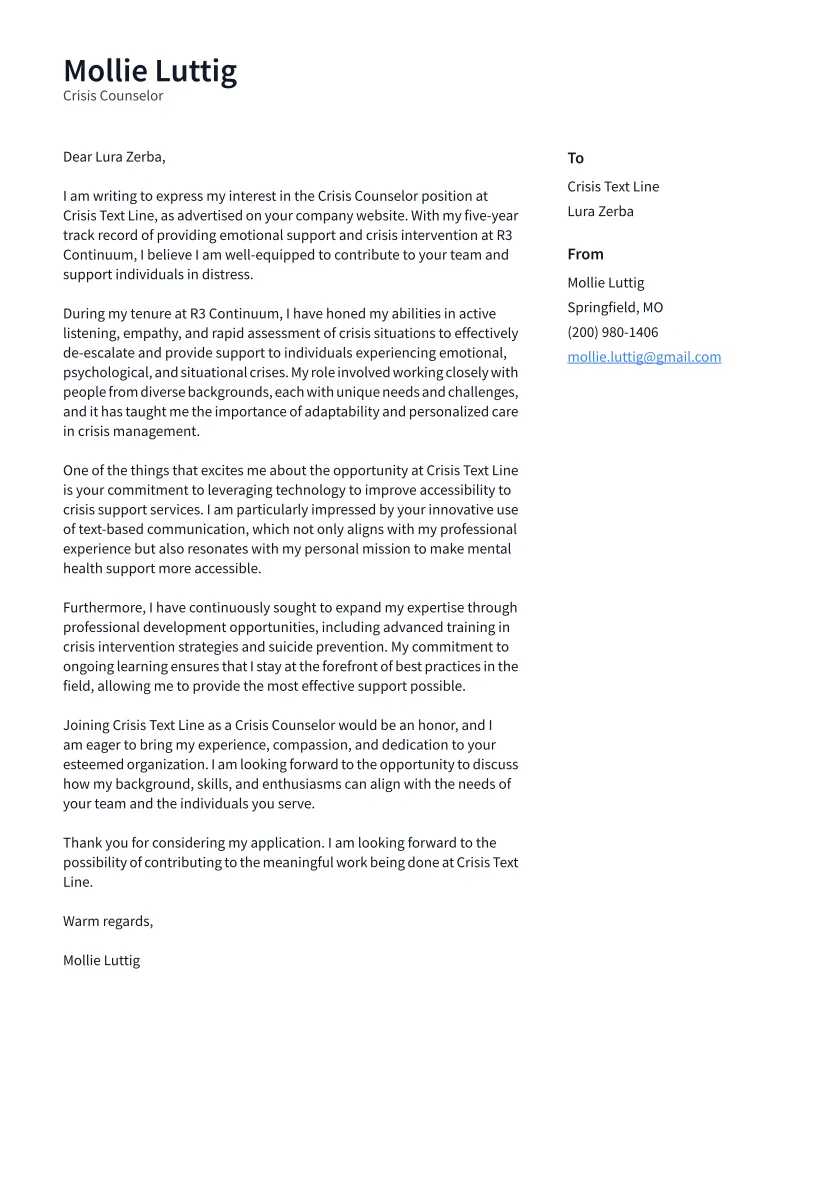
Crafting a Compelling Crisis Counselor Cover Letter
A well-crafted crisis counselor cover letter is your first opportunity to make a strong impression on potential employers. It serves as a crucial tool to showcase your skills, experience, and passion for helping individuals navigate difficult and often traumatic situations. This guide provides a comprehensive overview of how to create a cover letter that not only highlights your qualifications but also demonstrates your understanding of the demanding role of a crisis counselor. Your cover letter should be tailored to each specific job application, emphasizing the requirements outlined in the job description and illustrating how your background aligns with their needs. Remember, your cover letter is more than just a formality; it is a powerful marketing tool that can set you apart from other candidates and increase your chances of landing an interview. By following the steps outlined here, you can create a cover letter that effectively communicates your readiness and suitability for the role.
Understanding the Role of a Crisis Counselor
Before you begin writing your cover letter, it’s essential to have a clear understanding of the role of a crisis counselor. Crisis counselors provide immediate support and intervention to individuals experiencing emotional distress, mental health crises, or traumatic events. They often work in high-pressure environments, such as hotlines, emergency rooms, or community centers. A crisis counselor must be able to remain calm under pressure, communicate effectively, and quickly assess the needs of individuals in crisis. They provide emotional support, offer practical guidance, and help connect individuals with appropriate resources and services. A strong cover letter should reflect this understanding by demonstrating your awareness of these critical aspects of the job and highlighting your ability to meet them.
Key Responsibilities of Crisis Counselors

Crisis counselors undertake a variety of responsibilities, including providing immediate emotional support, conducting risk assessments, developing safety plans, and making referrals to other mental health professionals or support services. They also need to document client interactions accurately and maintain confidentiality. Crisis counselors are often involved in de-escalation techniques, helping individuals to manage intense emotions and regain control. They must possess excellent active listening skills, empathy, and the ability to remain objective while helping individuals navigate their crises. When writing your cover letter, be sure to incorporate your experience relating to these key responsibilities to illustrate your capabilities and suitability for the position.
Essential Skills for Crisis Counselors
Certain skills are crucial for success as a crisis counselor. These include active listening, empathy, clear communication, problem-solving, crisis intervention, and the ability to remain calm under pressure. Crisis counselors must also be skilled in de-escalation techniques, suicide assessment, and resource navigation. Additionally, strong interpersonal skills and cultural sensitivity are vital for building rapport with individuals from diverse backgrounds. Your cover letter should explicitly showcase your proficiency in these areas. You can achieve this by providing examples of situations where you successfully utilized these skills to help individuals in crisis. Including these skill sets will show the hiring manager that you are capable of effectively addressing the responsibilities of a crisis counselor.
Formatting Your Crisis Counselor Cover Letter
Proper formatting is essential for making your cover letter professional and easy to read. The format should be clean, concise, and visually appealing, ensuring that the hiring manager can quickly grasp the key information. Use a standard font like Times New Roman or Arial, and maintain a font size between 11 and 12 points. Employ single-spacing within paragraphs and double-spacing between paragraphs. A well-formatted cover letter reflects your attention to detail and professionalism, both of which are crucial traits for a crisis counselor. It is crucial to format your cover letter correctly, ensuring that it is easy to read and that the necessary information is easy to find. A well-structured letter will make it much more likely that your letter will be carefully reviewed.
Header and Contact Information

Your cover letter should begin with a header that includes your name, address, phone number, and email address. Ensure that your contact information is current and professional. Following the header, include the date, the name of the hiring manager (if known), their title, and the organization’s address. Including the hiring manager’s name adds a personal touch, demonstrating that you have researched the position and are genuinely interested in the opportunity. The accurate contact information is critical, as it enables the recruiter to easily reach you if they wish to schedule an interview.
Salutation and Opening
Use a professional salutation, such as “Dear Mr./Ms./Mx. [Last Name],” if you know the hiring manager’s name. If you don’t know the name, use a general salutation like “Dear Hiring Manager.” The opening paragraph should immediately grab the reader’s attention. State the position you are applying for and briefly explain where you saw the job posting. Then, concisely express your interest in the role and mention a key qualification or experience that makes you a strong candidate. A strong opening sets the tone for the rest of your letter, showing enthusiasm and highlighting your most impressive qualifications. The opening sets the stage for the rest of the letter and should indicate why you would be a strong candidate for the role.
Body Paragraphs Explaining Experience
The body of your cover letter is where you elaborate on your experience and skills. Focus on the qualifications outlined in the job description, providing specific examples of your past work. Describe your experiences in crisis intervention, de-escalation, suicide assessment, and any other relevant areas. Structure your paragraphs to highlight your accomplishments, skills, and how they align with the requirements of the position. Use the STAR method (Situation, Task, Action, Result) to provide clear and concise examples of your past experiences. This method enables you to effectively showcase the results you have achieved in previous crisis counseling roles. Ensure your examples are relevant, specific, and demonstrate your capabilities in helping individuals in crisis situations.
Highlighting Relevant Skills

In the body paragraphs, specifically highlight the skills that are most relevant to the crisis counselor role. Mention your active listening skills, empathy, communication abilities, and problem-solving skills. Provide concrete examples of how you have utilized these skills in previous roles. For instance, you could describe a situation where you successfully de-escalated a crisis by actively listening to an individual and using empathetic communication. Quantify your skills whenever possible, such as the number of clients you have assisted or the positive outcomes you have achieved. This ensures that your qualifications are easily understood and appreciated by the hiring manager, and will greatly improve your chances of getting the job.
Quantifying Achievements
Quantifying your achievements adds credibility to your cover letter. Use numbers and data to demonstrate your impact in previous roles. For example, instead of saying “I provided support to numerous clients,” state “I provided crisis intervention services to over 50 clients per month.” If you improved client outcomes, mention the percentage of clients who showed improvement. If you reduced wait times or increased client satisfaction, include these details. Quantifying your achievements gives the hiring manager a clear picture of your contributions and helps them assess your potential value to their organization. This can distinguish you from other candidates and will emphasize your accomplishments in previous crisis counselor positions.
Closing the Cover Letter
In your closing paragraph, reiterate your interest in the position and express your enthusiasm for the opportunity. Thank the hiring manager for their time and consideration. Include a call to action, such as inviting them to contact you for an interview. Ensure you provide your contact information again for easy reference. Maintain a professional tone and demonstrate that you are eager to learn more about the position. A strong closing leaves the reader with a positive impression, increasing the likelihood that they will contact you. A clear and concise closing will reinforce your qualifications and reiterate your commitment to the role.
Proofreading and Editing

Before submitting your cover letter, carefully proofread and edit it to eliminate any errors in grammar, spelling, and punctuation. Ensure that your cover letter flows logically and is easy to read. Ask a friend or colleague to review your letter for any mistakes you may have missed. A polished and error-free cover letter reflects your attention to detail and professionalism, crucial qualities for a crisis counselor. Mistakes in your cover letter can create a negative impression, indicating a lack of attention to detail. Reviewing your cover letter will assist you in making your cover letter as effective as possible, increasing your chances of being hired.