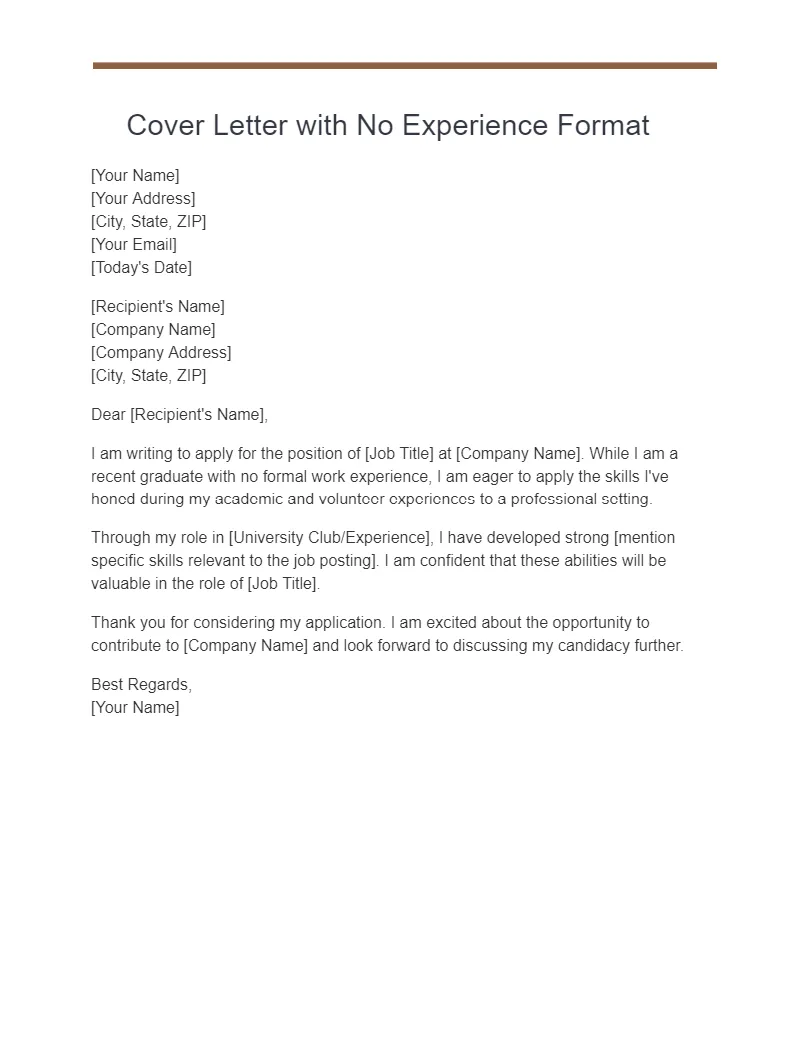
Cover Letter with No Experience What You Need
Writing a compelling cover letter when you lack professional experience can seem daunting but it’s absolutely achievable. The key is to shift your focus. Instead of dwelling on what you haven’t done, concentrate on what you can offer. Your cover letter is your opportunity to showcase your potential, highlight your transferable skills, and demonstrate your enthusiasm for the role and the company. This guide will walk you through the process, providing actionable tips and examples to help you create a standout cover letter that gets you noticed, even without a lengthy work history. Remember, every experience, whether academic, volunteer-based, or personal, offers valuable skills that can be translated into professional assets. Let’s unlock the potential within your experiences and create a cover letter that shines.
Understanding the Purpose of a Cover Letter
A cover letter serves as a crucial introduction, going beyond the basic information presented in your resume. It’s your chance to tell a story, to provide context for your application, and to demonstrate why you’re the perfect fit for the specific role and company. It allows you to express your personality, communicate your enthusiasm, and connect your skills and experiences to the employer’s needs. Think of it as a personalized sales pitch. Unlike a resume, which is a summary of your qualifications, a cover letter allows you to elaborate, providing examples and explaining how your skills align with the job requirements. The goal is to persuade the hiring manager to read your resume and, ultimately, invite you for an interview. With no professional experience, the cover letter becomes even more important to emphasize your potential and passion.
Highlighting Transferable Skills

Transferable skills are the key to unlocking your potential when you lack direct work experience. These are versatile abilities developed through various activities like education, volunteer work, extracurricular involvement, and personal projects. They can be applied across different jobs and industries. Identifying these skills is crucial for crafting an effective cover letter. Consider skills like communication, problem-solving, teamwork, time management, leadership, and adaptability. Think about situations where you’ve demonstrated these skills. For instance, if you organized a school event, you’ve likely honed your project management, communication, and organizational skills. If you were a team member on a sports team, you’ve likely developed teamwork, discipline, and the ability to work under pressure. The cover letter is your canvas to paint a picture of how these skills translate into value for the employer.
Identifying Your Skills and Experience
Start by making a comprehensive list of all your experiences. Include everything: academic projects, volunteer roles, internships (even if unpaid), extracurricular activities, personal projects, and any part-time jobs you’ve held. Once you have your list, go through each experience and identify the skills you used. For example, if you were a member of a debate club, you likely improved your public speaking, research, and critical thinking abilities. If you tutored a classmate, you probably developed your communication, patience, and ability to explain complex topics clearly. Don’t underestimate any experience. Even seemingly simple activities can reveal valuable skills. After identifying your skills, brainstorm ways you can demonstrate these skills in a professional setting. Show how your experience aligns with the job description.
Skills from Education
Your education provides a foundation of skills. Analyze the courses you’ve taken, projects you’ve completed, and group assignments you’ve participated in. Did you write research papers that honed your writing and analytical skills? Did you deliver presentations that sharpened your public speaking abilities? Did you work on group projects that improved your teamwork and problem-solving skills? Highlight relevant coursework and the skills you gained. For instance, a project involving data analysis would demonstrate your analytical and technical skills, which are applicable in fields like marketing or finance. Make sure you are specific when describing your skills. Instead of saying you have “good communication skills”, describe how you used them, such as “effectively communicated project findings to a diverse audience through concise and compelling presentations.”
Skills from Volunteer Work and Extracurricular Activities

Volunteer work and extracurricular activities offer a rich source of transferable skills. If you volunteered at a local charity, you might have developed customer service skills, organizational skills, and the ability to work in a team. If you were the treasurer of a club, you gained experience in financial management, budgeting, and attention to detail. Participation in a sports team teaches discipline, teamwork, and the ability to perform under pressure. Consider the roles you played in these activities. Did you lead a team? Did you manage a budget? Were you responsible for organizing events? These experiences demonstrate initiative, leadership, and the ability to take responsibility. These examples are also crucial to helping you build your portfolio and prepare for future professional endeavors. Be sure to include any awards or recognitions you received as a result of your volunteer work.
Formatting Your Cover Letter
Formatting your cover letter correctly is essential for making a positive first impression. A well-formatted letter is easy to read and shows that you pay attention to detail. Use a professional font like Times New Roman, Arial, or Calibri, with a font size of 11 or 12 points. Maintain consistent margins (typically one inch on all sides) and use single or 1.15 line spacing. Ensure your cover letter is no more than one page long; employers often quickly scan these documents. Break up the text with clear paragraphs and bullet points (when appropriate) to make it easy to read. Use a clear and concise language; avoid jargon or overly complex sentence structures. The structure of the cover letter should follow a logical flow: header, salutation, body paragraphs (introduction, body, and conclusion), and a closing. Maintain consistency throughout.
Header Information
Your header should include your contact information: your name, phone number, email address, and LinkedIn profile URL (optional). It’s also customary to include the date and the hiring manager’s name and title, if you know it. If you don’t know the hiring manager’s name, you can use a general greeting like “Dear Hiring Manager.” Always ensure your contact information is accurate and professional. Use a professional email address (e.g., john.doe@email.com) rather than a casual one. Your goal is to make it easy for the recruiter to contact you. Make sure your LinkedIn profile is up to date and reflects your skills and experience. The header sets the tone for your entire letter, so it needs to be clear, concise, and well-organized.
Professional Salutation

Start your cover letter with a professional salutation. Using the hiring manager’s name shows that you’ve done your research and are attentive to detail. If you don’t know their name, “Dear Hiring Manager” is a safe and appropriate alternative. Avoid generic salutations like “To Whom It May Concern” as they lack personalization. After the salutation, use a comma (,) rather than a colon (:). The salutation sets the tone for your entire letter, so make sure it’s respectful and professional. Your cover letter is your chance to impress the hiring manager, showing that you have the qualities they are looking for in an employee.
Crafting Your Cover Letter Body
The body of your cover letter is the most important part. It is where you’ll show the hiring manager how your skills, experiences, and aspirations align with the job requirements and the company’s values. Structure your cover letter in three main paragraphs: an introductory paragraph to grab their attention, body paragraphs to showcase your skills and provide evidence of your abilities, and a concluding paragraph to express your interest and call to action. Each paragraph should serve a specific purpose and contribute to the overall narrative of why you are the ideal candidate for the position, even without any experience.
First Paragraph Grab Attention
Your first paragraph should immediately grab the reader’s attention. Start by stating the position you’re applying for and how you found the job listing. Then, briefly highlight your most relevant skill or the key reason you’re excited about the role or the company. This should be concise and enthusiastic, creating a positive first impression. For instance, instead of saying “I am writing to apply for the marketing assistant position,” try something like “I am thrilled to apply for the Marketing Assistant position at [Company Name], as I believe my passion for digital marketing and my experience with social media aligns perfectly with your company’s goals.” Make sure that you customize your intro paragraph to the specific job description. The introduction is critical, as it sets the tone for the rest of the letter.
Second Paragraph Show Your Value

In the second paragraph, demonstrate your value. This is where you provide evidence of your skills, qualifications, and experiences. Since you may lack direct work experience, focus on highlighting transferable skills. Use specific examples from your education, volunteer work, extracurricular activities, or any personal projects. Describe the situation, the actions you took, and the results you achieved (the STAR method: Situation, Task, Action, Result). For example, “During my time as the treasurer of the university’s debate club, I managed a budget of $5,000, balancing income and expenses effectively. This experience helped me develop my organizational and financial management skills.” The goal is to show the hiring manager how you can contribute to the company. Make sure to align your skills and experiences with the job description.
Third Paragraph Highlight Your Enthusiasm
In the third paragraph, demonstrate your enthusiasm for the specific role and the company. This is a great place to show your research. Mention something specific that excites you about the company, its mission, or its culture. Explain why you are interested in the role and how it aligns with your career goals. Express your desire to learn and grow within the company. You might say something like, “I am particularly drawn to [Company Name]’s commitment to [company value or project]. I am eager to learn from experienced professionals and contribute to your team’s success.” This paragraph conveys your motivation and shows that you’ve taken the time to understand the company’s values and goals. This enthusiasm will make you stand out to the recruiter and hiring manager.
Closing Your Cover Letter
Your closing paragraph is your final opportunity to leave a lasting impression. Be polite, concise, and reiterate your interest in the position. Thank the hiring manager for their time and consideration. End with a call to action. A clear call to action encourages the hiring manager to take the next step, such as reviewing your resume or contacting you for an interview. Express confidence in your ability to contribute to the company’s success. It is customary to end your cover letter with a professional closing, such as “Sincerely” or “Best regards,” followed by your typed name. This provides a final touch of professionalism and respect.
Express Gratitude and Next Steps

In your closing, express your gratitude for the hiring manager’s time and consideration. Then, include a clear call to action. For instance, you could say, “Thank you for your time and consideration. I am eager to learn more about this opportunity and discuss how my skills and enthusiasm can benefit your team. I look forward to hearing from you soon.” Reiterate your contact information, so the hiring manager knows how to reach you easily. Consider including an invitation for an interview as well as the next steps to take with your application. A strong closing leaves the recruiter with a clear idea of how to proceed.
Cover Letter Mistakes Avoid Them
Several common mistakes can undermine your cover letter. Avoid generic cover letters. Tailor each letter to the specific job and company. Use the same language and tone as the job description. Don’t be overly wordy or verbose. Keep your cover letter to one page and use clear, concise language. Avoid typos, grammatical errors, and spelling mistakes. Always proofread carefully before submitting your application. Don’t focus on what you don’t have. Instead, highlight your potential and transferable skills. Avoid simply restating your resume. Your cover letter should provide additional context and insights. Avoid using clichés or buzzwords. Be authentic and genuine. A personalized, well-written cover letter greatly increases your chances of getting noticed.
Proofreading and Editing Your Cover Letter
Proofreading and editing are essential steps in the cover letter writing process. Errors can create a negative impression and make you seem careless. Always read your cover letter carefully for any errors in grammar, spelling, and punctuation. Check that your sentences are clear, concise, and easy to understand. Consider asking a friend, family member, or career advisor to review your cover letter. A fresh pair of eyes can often catch mistakes that you might miss. Pay attention to the formatting and ensure that it is consistent throughout. Check for any inconsistencies in font size, margins, or spacing. By taking the time to proofread and edit, you’ll ensure that your cover letter is polished, professional, and ready to impress.