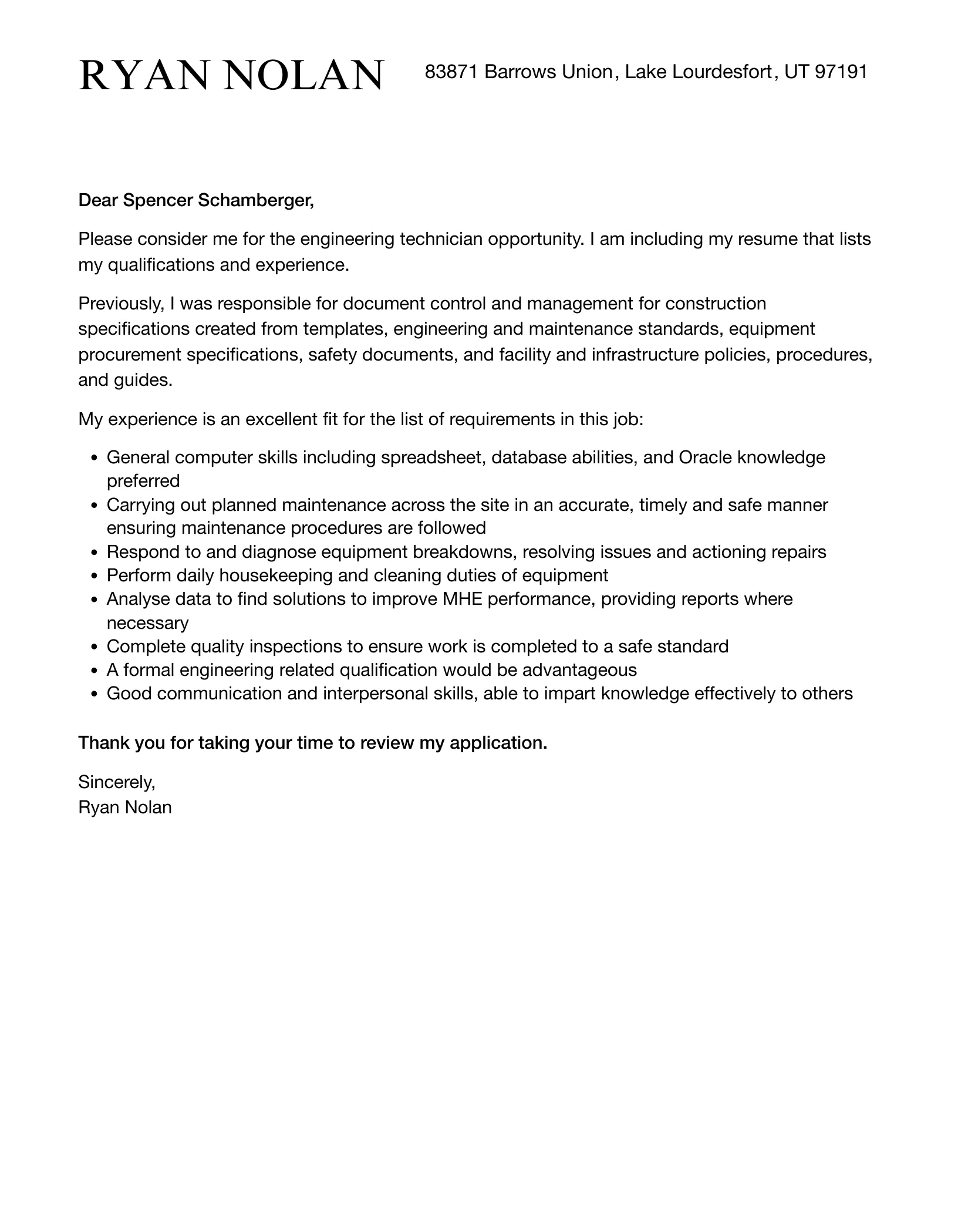
Crafting Your Engineering Technician Cover Letter
A well-crafted cover letter is your first opportunity to make a strong impression on potential employers. For an engineering technician, a cover letter isn’t just a formality it’s a crucial document that showcases your skills, experience, and enthusiasm for the role. This guide provides a comprehensive how-to, helping you create a compelling cover letter that grabs attention and increases your chances of landing an interview. We’ll delve into the essential elements, from understanding the engineering technician’s role to highlighting your achievements and avoiding common pitfalls. A strong cover letter demonstrates your understanding of the position and your ability to contribute to the company’s success.
Understanding the Role of an Engineering Technician
Before you start writing, it’s essential to understand the specific duties and responsibilities of an engineering technician. This understanding will help you tailor your cover letter to the specific job requirements. The role typically involves supporting engineers in various tasks, from design and development to testing and maintenance. Your cover letter must demonstrate a clear grasp of the technician’s role within an engineering team and the value you bring to the table.
Key Responsibilities of Engineering Technicians

Engineering technicians undertake a variety of tasks depending on their specialization, such as mechanical, electrical, or civil engineering. Common responsibilities include conducting tests, collecting and analyzing data, preparing reports, creating technical drawings, assisting with project planning, and ensuring quality control. The cover letter should reflect these key responsibilities and highlight relevant experiences. Think about what tasks you have performed, what equipment you have used, and what projects you have contributed to. Be specific, provide examples and quantify achievements whenever possible.
Essential Skills to Highlight
Your cover letter should prominently feature your technical skills and soft skills. These demonstrate your qualifications and suitability for the role. Be sure to align your skills with the requirements listed in the job description, emphasizing those that the employer values most. Use action verbs to describe your accomplishments and responsibilities.
Technical Skills
Technical skills are the backbone of an engineering technician’s job. Examples include proficiency in CAD software (AutoCAD, SolidWorks), experience with testing equipment (oscilloscopes, multimeters), knowledge of engineering principles (electrical circuits, mechanical systems), and the ability to read and interpret technical drawings. Be sure to list the specific software, tools, and techniques you are proficient in. If you have certifications or licenses, definitely mention them. Quantify your expertise by citing projects you worked on or the results you achieved.
Soft Skills

Soft skills are equally important, as they demonstrate your ability to work effectively in a team and manage your responsibilities. Examples include strong communication skills, problem-solving abilities, attention to detail, time management, and the ability to work independently. Showcasing your soft skills can be done by providing examples. For instance, describe a time you solved a difficult technical problem, worked collaboratively on a project, or managed multiple tasks under pressure. Mention your skills that shows you are a good fit in their team.
Structuring Your Cover Letter
A well-structured cover letter is easy to read and navigate. Use clear headings, concise paragraphs, and a professional tone. Aim for a length of one page, ensuring that you cover all the key points without being overly verbose. The structure includes a header with contact information, an introductory paragraph, body paragraphs highlighting achievements, and a closing paragraph. A well-structured letter shows you have great organizational skills.
Header and Contact Information
Start with a header that includes your name, address, phone number, and email address. This information should be clearly visible at the top of the document. It should be professional and easy to read. Also include the date and the hiring manager’s name and title if known. This ensures that the employer can easily reach you. Double-check all contact details for accuracy to avoid any miscommunication or missed opportunities.
The Introductory Paragraph

The introductory paragraph should immediately grab the reader’s attention. State the position you’re applying for, where you saw the job posting, and a brief statement of your interest. Highlight one or two key skills or experiences that make you a good fit for the role. Show your enthusiasm and your understanding of the company. This paragraph sets the tone for the rest of the letter, so make it compelling and direct.
Body Paragraphs Highlighting Achievements
The body paragraphs are the meat of your cover letter. Use these paragraphs to describe your relevant experience, skills, and accomplishments. Provide specific examples of how you have applied your skills and what results you achieved. Use the STAR method (Situation, Task, Action, Result) to structure your responses and provide clear, concise narratives. Quantify your accomplishments whenever possible.
Tailoring to the Job Description
Carefully review the job description and tailor your cover letter to the specific requirements. Use the same keywords and phrases used in the job posting. This demonstrates that you have read the job description and that you understand the employer’s needs. Customize your letter for each job application to show that you’ve put in the effort.
Quantifying Accomplishments

Whenever possible, quantify your accomplishments to make them more impactful. Use numbers and data to demonstrate your success. For example, instead of saying “Improved efficiency,” say “Improved efficiency by 15% by implementing a new testing protocol.” Quantifiable results give the employer a clear understanding of your impact. Numbers are more memorable and show that you can deliver results.
The Closing Paragraph
In the closing paragraph, reiterate your interest in the position, express your enthusiasm for the company, and thank the reader for their time and consideration. Include a call to action, such as encouraging them to contact you for an interview. Keep it concise and professional. Express your availability and willingness to discuss your qualifications further.
Formatting and Proofreading
Formatting and proofreading are critical for a professional cover letter. A well-formatted letter is easy to read and reflects your attention to detail. Proofreading eliminates errors and ensures that your letter is polished and error-free.
Choosing the Right Font and Style

Choose a professional font such as Times New Roman, Arial, or Calibri in a size between 10 and 12 points. Use consistent formatting throughout your cover letter, including line spacing, margins, and bullet points. Ensure your cover letter is visually appealing. A clean and well-organized layout makes the letter more readable.
Proofreading for Errors
Proofread your cover letter carefully for any grammatical errors, spelling mistakes, and punctuation errors. Ask a friend or colleague to review your letter as a second pair of eyes can catch errors you may have missed. Ensure all names, titles, and company names are correct. Double-check all contact information. A mistake-free cover letter demonstrates your professionalism and attention to detail.
Example Cover Letter Sections
To provide concrete examples, here are sample sections to guide your cover letter writing.
Header Example

John Doe 123 Main Street Anytown, CA 12345 (555) 123-4567 john.doe@email.com October 26, 2023
Hiring Manager Acme Engineering 456 Oak Avenue Anytown, CA 67890
Introductory Paragraph Example
Dear Hiring Manager, I am writing to express my enthusiastic interest in the Engineering Technician position at Acme Engineering, as advertised on LinkedIn. With five years of experience in electrical testing and maintenance, and a proven track record of improving system performance, I am confident I possess the skills and experience necessary to excel in this role.
Body Paragraph Example Highlighting Skills
In my previous role at Beta Technologies, I was responsible for conducting electrical tests and troubleshooting system malfunctions. I am proficient in using oscilloscopes, multimeters, and signal generators. I have extensive experience in reading and interpreting technical drawings. I improved the reliability of the systems by 20% by implementing a new diagnostic procedure, which decreased downtime.
Closing Paragraph Example

Thank you for considering my application. I am eager to contribute my skills and experience to Acme Engineering. I am available for an interview at your earliest convenience and can be reached at (555) 123-4567 or john.doe@email.com. I look forward to hearing from you soon.
Common Mistakes to Avoid
Avoid common mistakes that can hinder your application. Proofread your cover letter to ensure there are no spelling or grammatical errors. These mistakes are common and can easily be avoided with a proofread. Make sure the information is clear. Writing mistakes are easily avoidable, and you should ensure your details and information is clear and precise. Generic cover letters, that don’t show your genuine interest in the role and the company, are a very common mistake. Generic letters are not tailored to the job description, and don’t show your level of enthusiasm.