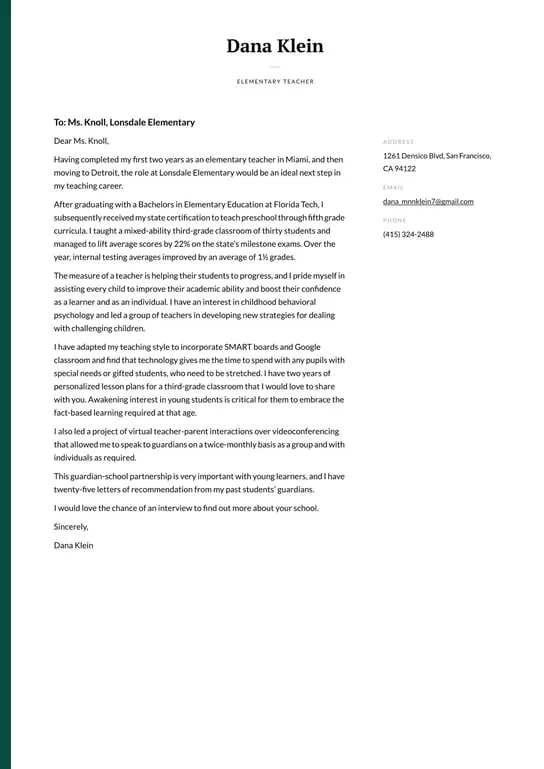
Understanding the Importance of a Cover Letter
In the competitive field of elementary education, a well-crafted cover letter is your first opportunity to make a strong impression. It’s your chance to introduce yourself to the hiring committee, showcase your passion for teaching, and highlight why you are the ideal candidate for the position. A cover letter isn’t merely a formality; it’s a crucial tool that complements your resume, providing context and personality that a list of qualifications alone cannot convey. This document allows you to connect with the school on a personal level and demonstrate your unique teaching philosophy, which is vital for securing an interview and ultimately, landing your dream job.
Why a Cover Letter Matters for Elementary Teachers
For elementary school teachers, the cover letter takes on an even greater significance. It’s where you can express your dedication to nurturing young minds, fostering a love of learning, and creating a supportive classroom environment. Elementary schools often seek teachers who are not only qualified but also possess empathy, patience, and a genuine enthusiasm for working with children. Your cover letter is the ideal platform to communicate these qualities. Furthermore, it allows you to address any specific needs or values of the school, proving that you’ve done your research and are genuinely interested in becoming a part of their community.
Highlighting Your Unique Teaching Philosophy

Your teaching philosophy is the cornerstone of your approach to education, and your cover letter offers the perfect space to articulate it. Briefly explain your beliefs about how children learn best. Do you prioritize hands-on activities, collaborative projects, or differentiated instruction? Mentioning your philosophy allows the school to understand your alignment with their educational values. For example, if you are a proponent of project-based learning, briefly describe how you incorporate it into your lessons and the positive outcomes you’ve witnessed. This shows potential employers that you are a thoughtful and intentional educator.
Demonstrating Your Passion for Education
Passion is contagious, and your cover letter should be filled with it. Share your enthusiasm for working with elementary-aged children and the joy you find in seeing them learn and grow. Consider including a brief anecdote that illustrates your passion, such as a memorable moment from your student teaching experience or a particular success story. This personal touch can make your application stand out. Mentioning professional development experiences, workshops, or certifications that demonstrate your commitment to continuous learning also demonstrates your dedication to your profession. Make your passion evident throughout the letter, showing that teaching is not just a job for you, but a calling.
Key Components of a Compelling Cover Letter
A well-structured cover letter follows a clear and logical format. Begin with your contact information, the date, and the school’s address. Address the letter to the hiring manager or principal, if possible. The body of your letter should consist of an engaging opening paragraph, a section highlighting your qualifications and experience, a paragraph emphasizing your skills, and a strong closing paragraph. Proofread every word to ensure that the letter is free of errors. A polished, professional presentation is critical to leaving a positive impression.
Your Contact Information and Formal Salutation

Start with your full name, address, phone number, and email address at the top of the letter. This ensures that the hiring manager can easily reach you. Then, include the date, followed by the school’s name and address. The salutation should be formal. If you know the hiring manager’s name, address the letter to them (e.g., “Dear Mr. Smith”). If not, use a general greeting such as “Dear Hiring Committee” or “To Whom It May Concern.” These details set a professional tone from the outset.
Crafting a Strong Opening Paragraph
The opening paragraph is your first opportunity to capture the reader’s attention. State the position you are applying for and how you learned about it (e.g., through the school’s website, a job board, or a personal referral). Briefly express your enthusiasm for the opportunity and why you are interested in the school. Mention a unique skill or achievement that immediately grabs the reader’s interest. A strong opening paragraph sets the tone for the rest of your letter and encourages the hiring committee to keep reading.
Showcasing Your Qualifications and Experience
In this section, provide a concise overview of your relevant qualifications and experience. Reference your teaching credentials, degrees, and any special certifications you possess. Highlight your past teaching experiences, including the grade levels you taught and the schools you worked at. Focus on experiences that align with the requirements of the position and the school’s mission. Mention specific achievements and contributions that demonstrate your effectiveness as a teacher. Back up your claims with concrete examples and data whenever possible.
Highlighting Relevant Skills and Achievements

This is where you emphasize your most relevant skills and accomplishments. Mention any specific teaching methods, strategies, or technologies you are proficient in, such as differentiated instruction, classroom management techniques, or the use of educational software. Quantify your achievements whenever possible. Did you improve student test scores? Reduce disciplinary incidents? Implement a successful new program? Provide specific examples of your achievements. Showcase leadership experience, such as leading committees or mentoring new teachers, is also a valuable asset that schools seek.
Tailoring Your Letter to the Specific School
One of the most effective ways to make your cover letter stand out is to customize it for each school. Research the school’s mission, values, and programs. Mention any specific initiatives that resonate with your teaching philosophy. If the school emphasizes a particular pedagogical approach (e.g., Montessori, project-based learning), highlight your experience or interest in that area. Showing that you understand the school’s unique needs and aspirations demonstrates your genuine interest in joining their community.
Addressing the School’s Needs and Values
Carefully review the job description and identify the school’s key requirements and priorities. Address these needs directly in your cover letter. Do they emphasize student engagement, parent communication, or a focus on STEM education? Demonstrate how your skills and experience align with these priorities. Mention any relevant experience or training that specifically addresses these needs. By showing the school that you are a good fit for their specific context, you significantly increase your chances of getting an interview.
Quantifying Your Accomplishments with Data

Whenever possible, use data to support your claims and demonstrate your effectiveness. Instead of saying, “I improved student test scores,” quantify the improvement by saying, “I increased student scores by 15% on the end-of-year reading assessment.” Similarly, if you implemented a new classroom management strategy, mention the reduction in disciplinary incidents. Providing concrete data strengthens your application and gives the hiring committee a clear understanding of your impact. This shows the ability to measure and track results, which is an important aspect of effective teaching.
Creating a Powerful Body Paragraph
The body of your cover letter should contain a well-developed paragraph that effectively conveys your key qualifications and skills. Elaborate on the experiences mentioned in your resume. Use the STAR method (Situation, Task, Action, Result) to describe specific examples of your teaching accomplishments. Provide context (the situation), explain your role (the task), describe the actions you took, and highlight the positive outcomes (the results). This structure provides concrete examples and shows your impact.
Mentioning Specific Teaching Strategies
To further enhance your letter, mention specific teaching strategies you employ. Include details on how you differentiate instruction to meet the needs of diverse learners. If you have experience with specific curriculum models, highlight them. Mention your proficiency in integrating technology into your lessons to enhance student engagement. Be specific and give examples of how these strategies have improved student outcomes. Demonstrate that you are not just familiar with these strategies, but that you use them effectively in your classroom.
Showcasing Classroom Management Skills

Effective classroom management is crucial in elementary education, so be sure to showcase your skills in this area. Describe the strategies you use to create a positive and productive learning environment. Do you utilize positive reinforcement techniques, establish clear expectations, or incorporate restorative practices? Mentioning specific strategies shows you have a proven track record. You may also discuss how you address challenging behaviors, and the steps you take to maintain a respectful classroom environment where all students feel safe and supported.
Expressing Your Enthusiasm for the Position
Convey your excitement for the specific position and the opportunity to join the school’s team. Explain why you are particularly drawn to the school, its values, and its community. Show that you have researched the school and are genuinely interested in becoming a part of it. Mention specific programs or initiatives that you find exciting. Let your passion shine through and demonstrate that you are not just applying for a job, but are eager to contribute to the school’s success. Expressing enthusiasm makes you more memorable.
Creating a Memorable Closing
The closing paragraph should be concise and leave a lasting impression. Thank the hiring committee for their time and consideration. Reiterate your enthusiasm for the opportunity. Summarize your key qualifications and highlight your suitability for the position. A well-crafted closing paragraph reinforces your interest and encourages the hiring committee to take the next step: contacting you for an interview.
Reiterating Your Interest and Gratitude

In your closing, reiterate your strong interest in the position and the school. Briefly summarize why you are a good fit and what you can bring to the team. Express your gratitude for the hiring committee’s time and consideration, thanking them for reading your application. This shows respect and professionalism. A simple and sincere closing leaves a positive impression.
Including a Call to Action and Next Steps
End your cover letter with a clear call to action. Express your eagerness to discuss your qualifications further and provide your contact information. State that you are available for an interview at their earliest convenience. Also, mention that your resume is attached and that you are available to provide references upon request. Making it easy for them to contact you increases the likelihood of getting the interview. This ensures that the hiring manager knows how to proceed.
Proofreading and Formatting Your Cover Letter
Before sending your cover letter, meticulous proofreading is essential. Check for spelling errors, grammatical mistakes, and inconsistencies in formatting. Read the letter aloud to catch any awkward phrasing or unclear sentences. Ensure your letter is visually appealing and easy to read. Use a professional font (e.g., Times New Roman, Arial) and maintain consistent formatting throughout. A clean, well-formatted cover letter shows attention to detail and professionalism. Consider having a trusted friend, colleague, or mentor review your cover letter before submitting it.
Ensuring Error-Free Content and Professional Appearance
The final step is to ensure your cover letter is error-free and presents a professional appearance. Proofread the letter multiple times. Check for any typos, incorrect grammar, or formatting inconsistencies. Verify that all the information you provide is accurate and current. Ensure that your letter is well-organized, easy to read, and reflects a professional tone. A polished cover letter demonstrates your attention to detail and increases your chances of landing an interview, ultimately leading to your dream job as an elementary school teacher.