Crafting a Compelling Clothing Store Cover Letter
A well-crafted clothing store cover letter is your first opportunity to impress a potential employer. It’s your chance to showcase your personality, skills, and enthusiasm for the role. Unlike a resume, which provides a summary of your experience, a cover letter allows you to connect with the hiring manager on a personal level, explaining why you’re the perfect fit for their team. This guide will walk you through every step, from understanding the purpose of a cover letter to tailoring it for each specific job application. Mastering the art of the cover letter is a crucial step in landing your dream job at a clothing store.
Understanding the Purpose of a Cover Letter
The primary purpose of a cover letter is to introduce yourself and express your interest in a specific job. It’s not just a formality; it’s an opportunity to sell yourself and highlight what makes you unique. A cover letter complements your resume by providing context and demonstrating your passion for the clothing store industry. It allows you to elaborate on your experiences, explain your career goals, and demonstrate your understanding of the company’s values and the specific role. A compelling cover letter can significantly increase your chances of getting an interview.
Highlighting Relevant Skills and Experience

When writing your clothing store cover letter, it’s essential to focus on the skills and experiences that align with the job requirements. Carefully review the job description and identify the key qualifications the employer is seeking. Tailor your cover letter to demonstrate how your skills and experiences meet these needs. Provide specific examples to illustrate your achievements and the positive impact you’ve made in previous roles. This section is where you demonstrate to the hiring manager that you are not only qualified but also a valuable asset to the team. Use action verbs to describe your accomplishments.
Identifying Key Skills for Clothing Store Positions
Clothing store positions require a diverse set of skills. Focus on those that are most relevant to the job you are applying for. Consider highlighting skills like customer service, sales, communication, product knowledge, and merchandising. Emphasize any experience you have with point-of-sale (POS) systems, inventory management, or visual display. Demonstrate your ability to work independently, as well as part of a team. Employers look for candidates who are enthusiastic, reliable, and possess a strong work ethic. Highlighting these skills will make your application stand out.
Demonstrating Customer Service Abilities
Customer service is paramount in the clothing store industry. Showcase your ability to provide excellent customer service by highlighting experiences where you’ve assisted customers, resolved issues, or exceeded their expectations. Provide examples of how you’ve handled difficult customers or situations. Mention your ability to build rapport, understand customer needs, and offer personalized recommendations. Demonstrate your communication skills, including active listening and clear, concise explanations. Employers seek candidates who are patient, friendly, and adept at creating a positive shopping experience.
Showcasing Sales and Merchandising Skills

If the role involves sales or merchandising, make sure to emphasize those skills. Detail your experience with sales techniques, such as upselling and cross-selling. Describe any experience you have with visual merchandising, including creating appealing displays and organizing merchandise to maximize sales. Highlight your ability to meet or exceed sales targets. Showcase any experience with inventory management or stocktaking. Mention your understanding of fashion trends and your ability to advise customers on current styles. This will demonstrate your commitment to driving sales and contributing to the store’s success.
Structuring Your Clothing Store Cover Letter
A well-structured cover letter is easy to read and makes a positive impression. Follow a standard format: header, greeting, body paragraphs, and closing. Each section serves a specific purpose and contributes to your overall message. Use a professional font, clear formatting, and appropriate spacing to enhance readability. A well-organized cover letter shows attention to detail, which is a crucial attribute in any retail environment. Remember to keep it concise, usually one page in length, and focus on the key points that make you a good candidate.
Header and Contact Information
Start your cover letter with your contact information, including your name, address, phone number, and email address. This information should be placed at the top left or right of the document. Also, include the date and the hiring manager’s name and title if you know it. If you are unsure, you can use the title of the position or address the letter to ‘Hiring Manager.’ Make sure your contact information is accurate and up-to-date. Ensure your email address is professional.
Professional Greeting

Use a professional greeting, such as ‘Dear Mr./Ms./Mx. [Last Name]’ if you know the hiring manager’s name. If you don’t know the name, use ‘Dear Hiring Manager’ or ‘Dear [Clothing Store Name] Team’. Avoid using overly casual greetings. It is important to maintain a professional tone throughout the cover letter. This sets the right tone from the beginning and shows respect for the potential employer. Always double-check the spelling of the hiring manager’s name to show your attention to detail.
Body Paragraphs
The body of your cover letter is where you sell yourself. It typically consists of three paragraphs that introduce your interest, highlight your qualifications, and express your enthusiasm. Each paragraph should have a clear purpose and contribute to your overall message. The first paragraph should state your purpose, the second should highlight your key skills, and the third should express your enthusiasm and call for action. Avoid vague language; use concrete examples to support your claims.
First Paragraph: Stating Your Interest
In the first paragraph, clearly state the position you are applying for and how you found the job listing. Briefly mention why you are interested in the role and the company. Show your knowledge of the company and its values. This paragraph should grab the reader’s attention immediately. Demonstrate your eagerness to contribute to the team and start the conversation on a positive note. Keep it concise and specific to the job.
Second Paragraph: Showcasing Qualifications

This is where you highlight your relevant skills and experiences. Refer back to the job description and specifically mention the skills and qualifications the employer is seeking. Provide examples of how you’ve demonstrated these skills in the past. Use the STAR method (Situation, Task, Action, Result) to describe your accomplishments. Quantify your achievements whenever possible (e.g., ‘Increased sales by 15%’). This is the heart of your cover letter, so make sure it’s persuasive.
Third Paragraph: Expressing Enthusiasm
In the third paragraph, express your enthusiasm for the opportunity and the company. Explain why you are excited about the specific role and why you are a good fit for their culture. Mention any research you have done on the company and what you admire about their brand or values. Restate your interest and reiterate your key skills. Conclude with a strong call to action to encourage the hiring manager to contact you.
Closing and Call to Action
Conclude your cover letter with a polite and professional closing, such as ‘Sincerely’ or ‘Best regards.’ Reiterate your interest in the position and thank the hiring manager for their time and consideration. Include a clear call to action, such as ‘I look forward to hearing from you’ or ‘I am available for an interview at your earliest convenience.’ Provide your contact information again if necessary. Your closing should leave a lasting positive impression.
Formatting and Proofreading

Formatting and proofreading are essential steps in creating a professional cover letter. Proper formatting makes your letter easy to read and ensures that your message is conveyed clearly. Proofreading eliminates errors that could undermine your credibility. Pay close attention to details; a cover letter full of errors can send the wrong message to the potential employer. Take your time to perfect both the content and presentation of your cover letter.
Ensuring Professional Formatting
Use a professional font such as Times New Roman, Arial, or Calibri, with a font size between 10 and 12 points. Use single-spacing for the body of the letter and add a space between paragraphs. Use left alignment, except for the date and closing, which can be right-aligned. Ensure your margins are standard (1 inch on all sides). Make sure there are no grammatical errors or formatting inconsistencies. A well-formatted cover letter is a reflection of your attention to detail.
Proofreading for Errors
Proofread your cover letter carefully to eliminate any spelling, grammatical, or punctuation errors. Read the letter multiple times, and consider reading it aloud. Use a grammar and spell checker, but don’t rely on it completely; it’s important to do a thorough review yourself. Ask a friend, family member, or career counselor to review it for you. Typos and errors can create a negative impression, so take the time to ensure your cover letter is error-free. Proofreading is a crucial step in the cover letter writing process.
Tailoring Your Cover Letter

Each cover letter should be tailored to the specific job and company you are applying for. Generic cover letters rarely make a strong impression. Tailoring your cover letter shows the hiring manager that you have done your research and are genuinely interested in the role. Customization is key to demonstrate your understanding of the company’s needs and show your suitability for the specific position.
Researching the Clothing Store
Before writing your cover letter, research the clothing store. Visit their website, social media profiles, and, if possible, their physical store. Learn about their brand, values, target audience, and current collections. This information will help you customize your cover letter and demonstrate your understanding of the company’s mission and culture. Mention something specific you admire about the store or their products.
Customizing Your Letter for the Role
Carefully review the job description and tailor your cover letter to match the specific requirements and responsibilities of the role. Use keywords from the job description in your cover letter. Highlight the skills and experiences that are most relevant to the position. Provide examples that demonstrate how your skills align with the job’s requirements. Customization shows that you’ve taken the time to understand the role and are a good fit for the position.
Sample Cover Letter Template
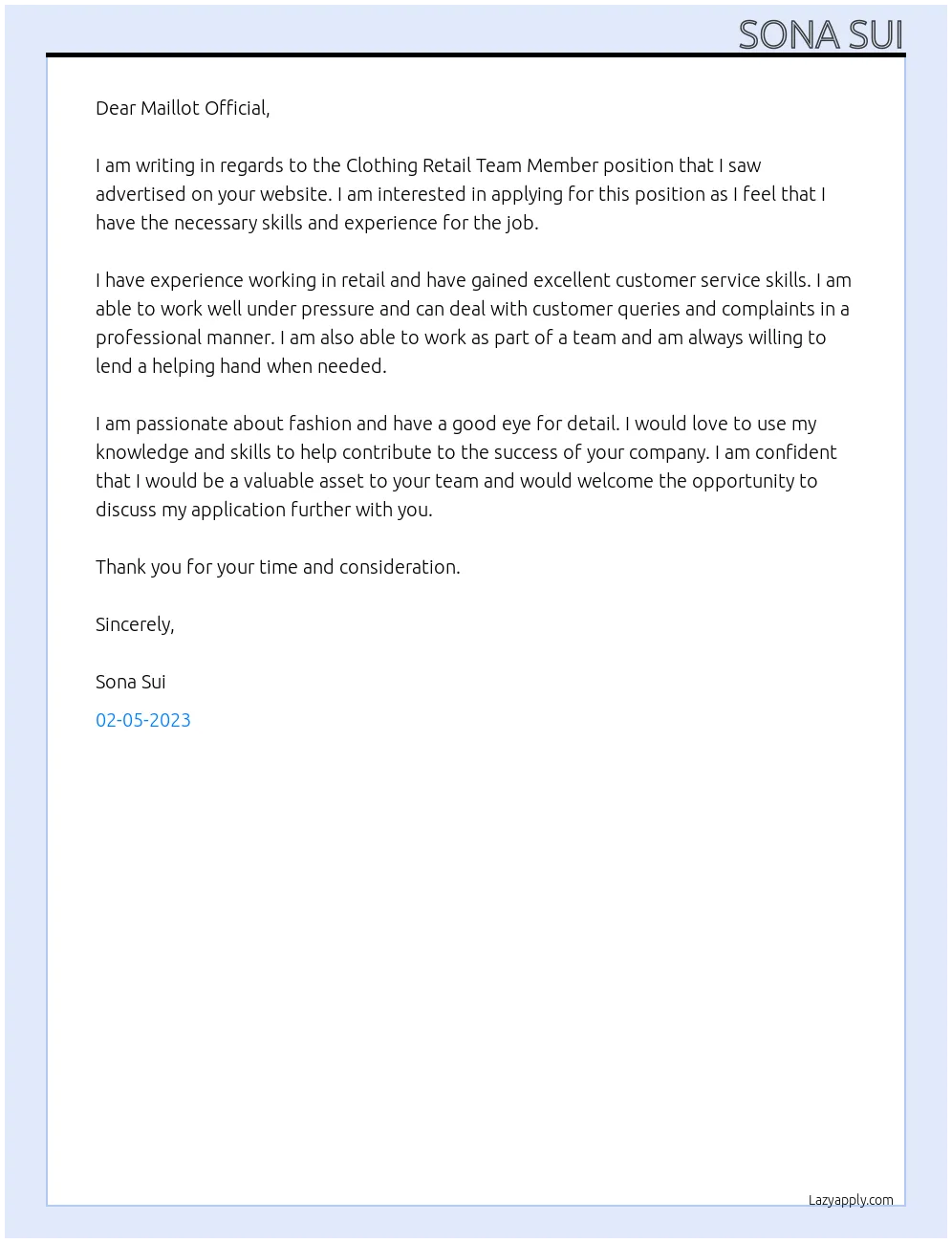
While every cover letter should be tailored to the specific role, a template can help you get started. Here is a basic template to get you started. [Your Name] [Your Address] [Your Phone Number] [Your Email Address] [Date] [Hiring Manager Name] [Hiring Manager Title] [Clothing Store Name] [Clothing Store Address] Dear [Mr./Ms./Mx. Last Name], I am writing to express my interest in the [Job Title] position at [Clothing Store Name], as advertised on [Platform]. I was particularly drawn to [mention something specific about the role or company]. In my previous role at [Previous Company], I [briefly describe relevant experience]. I am confident that my skills and experience align with the requirements of this position. I am eager to learn more about this opportunity. Thank you for your time and consideration. Sincerely, [Your Name] Remember to customize this template with your own information and experiences.