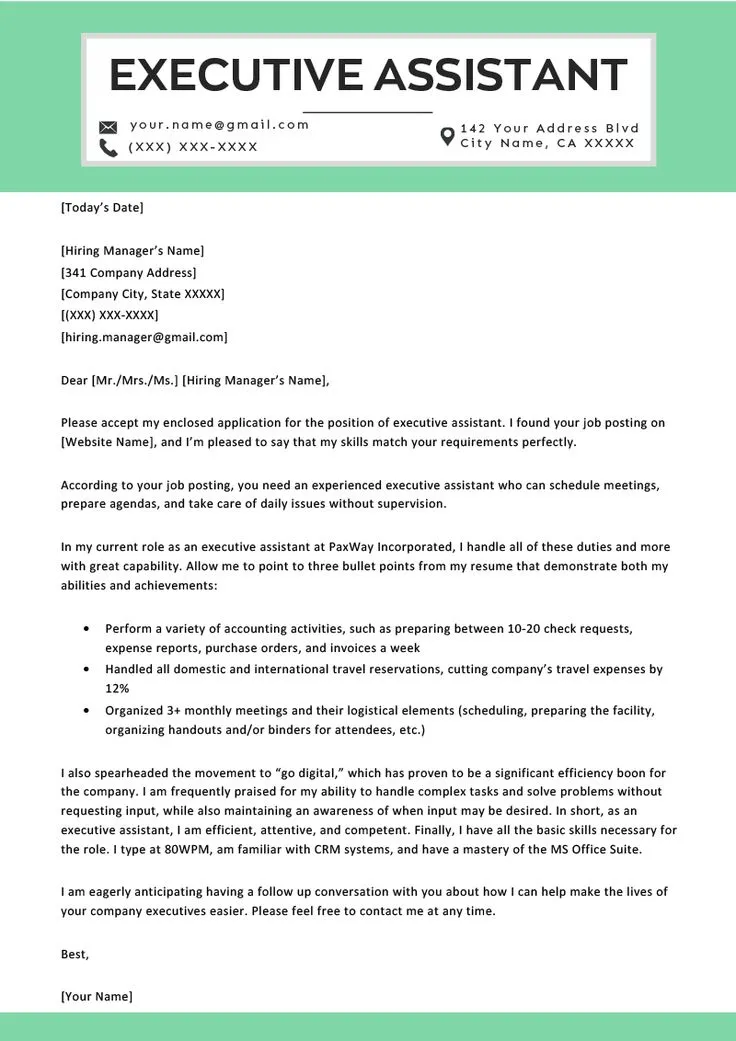
Crafting the Best Executive Assistant Cover Letter
In the competitive landscape of executive assistant roles, a well-crafted cover letter is your first opportunity to make a lasting impression. It’s your chance to go beyond the confines of your resume and demonstrate your unique value proposition. A strong cover letter doesn’t just reiterate your experience; it tells a compelling story that showcases your skills, achievements, and enthusiasm for the specific position and company. This guide will walk you through the essential elements and strategies for creating an executive assistant cover letter that stands out from the crowd and secures you an interview. We will explore how to highlight your most relevant skills, quantify your accomplishments, and tailor your letter to each application, ensuring that you present yourself as the ideal candidate for the role.
Understanding the Importance of a Cover Letter
Many job seekers underestimate the power of a cover letter, viewing it as a mere formality. However, a cover letter serves as a critical tool in the job application process, especially for executive assistant positions where attention to detail and communication are paramount. It provides a platform to express your personality, enthusiasm, and understanding of the role. A well-written cover letter demonstrates your ability to communicate effectively, which is a fundamental requirement for any executive assistant. It allows you to connect your skills and experience directly to the specific needs of the employer. A strong cover letter shows you have taken the time to research the company and understand what they are looking for in an executive assistant. It helps you to differentiate yourself from other candidates, particularly when the resume alone may not fully convey the breadth of your capabilities or your alignment with the company culture.
Highlighting Your Skills and Experience

Your executive assistant cover letter is the ideal space to highlight your most relevant skills and experience. This isn’t just a list of your responsibilities; it’s an opportunity to illustrate how your skills have translated into tangible results. Begin by identifying the core competencies the employer seeks. Review the job description closely, noting the key requirements and desired qualifications. Then, select the experiences and skills that directly align with these needs. For instance, if the job emphasizes organization and time management, provide specific examples of how you’ve successfully managed complex schedules, coordinated multiple projects simultaneously, or implemented systems that improved efficiency. The goal is to demonstrate, not just state, your abilities. Use action verbs to describe your accomplishments, such as ‘managed,’ ‘coordinated,’ ‘streamlined,’ and ‘implemented.’
Key Skills for Executive Assistants
Executive assistants require a diverse skill set to excel in their roles. The best cover letters showcase these key competencies in a concise and impactful manner. Focus on the skills that are most relevant to the specific job. This might include strong organizational skills, advanced proficiency in communication (both written and verbal), a deep understanding of office management, the ability to manage complex schedules, and strong interpersonal abilities. Think about your ability to multitask effectively, manage confidential information with discretion, and provide high-level administrative support. Also consider highlighting your ability to work independently and as part of a team, adapt to changing priorities, and use various software and technology tools.
Administrative Proficiency
Administrative proficiency is the bedrock of a successful executive assistant. This encompasses various skills, including managing calendars, organizing meetings, handling correspondence, and preparing reports. Your cover letter should spotlight instances where you’ve excelled in these areas. Be specific. Instead of stating you’re good at managing schedules, describe how you’ve streamlined executive calendars to maximize productivity. Show how you’ve improved meeting efficiency by creating and distributing detailed agendas. Illustrate how you have a strong handle on written and verbal communications, creating, editing, and distributing communications with appropriate professionalism. Detail any experience in maintaining and managing databases, filing systems, and record keeping, emphasizing accuracy and efficiency. By demonstrating your strong administrative skills, you reassure the hiring manager that you can keep everything running smoothly.
Communication and Interpersonal Skills

Effective communication and strong interpersonal skills are vital for an executive assistant. You will be the primary point of contact for the executive. Your cover letter should showcase your ability to communicate clearly and professionally, both verbally and in writing. Describe situations where you’ve successfully interacted with clients, vendors, and high-level executives. For example, provide a strong example of how you have drafted and edited correspondence on behalf of an executive, ensuring accuracy and proper tone. Highlight your ability to build rapport and establish positive working relationships. Emphasize your skills in active listening, conflict resolution, and handling sensitive information with discretion. Your ability to communicate effectively and build relationships will give you the ability to coordinate and represent the executive well.
Organizational and Time Management Skills
Executive assistants must possess exceptional organizational and time management skills to handle a multitude of tasks simultaneously. Showcase your ability to prioritize tasks, manage deadlines, and maintain a well-organized workspace. Highlight any systems or tools you have used to improve efficiency, such as project management software or digital calendar applications. Detail your process for prioritizing tasks, managing deadlines, and handling unexpected changes. The hiring manager needs to know you can handle complex schedules, coordinate multiple projects, and ensure everything runs smoothly. Provide an example of a time you successfully managed a demanding project or coordinated multiple events, ensuring everything ran on schedule and within budget. By demonstrating your abilities in these areas, you’ll show that you are capable of keeping everything under control.
Showcasing Your Achievements
Rather than simply listing your duties, focus on demonstrating your accomplishments. What results have you achieved in your previous roles? Quantify your achievements whenever possible. Did you improve efficiency? Reduce costs? Improve communication flow? Providing specific, measurable outcomes makes your accomplishments more impactful and shows the hiring manager the value you bring. Use the STAR method (Situation, Task, Action, Result) to structure your examples. This method helps you provide context, describe the challenge, explain your actions, and detail the outcome. The more concrete examples you can provide, the more compelling your cover letter will be.
Quantify Your Accomplishments

Quantifying your accomplishments is crucial for making a strong impression. Use numbers and metrics to demonstrate the impact of your work. Instead of saying “improved meeting efficiency,” state that you “reduced meeting times by 15% through the implementation of a new agenda system.” Instead of saying you “managed projects,” specify that you “successfully managed over 20 projects simultaneously, all completed on time and within budget.” Quantifying your accomplishments provides concrete evidence of your abilities and allows the hiring manager to clearly see your value. Be as specific as possible and use data to illustrate the positive results you have achieved.
Tailoring Your Cover Letter
One of the most effective ways to make your cover letter stand out is to tailor it to each specific job application. Generic cover letters often fail to capture the attention of hiring managers. Customizing your letter demonstrates that you’ve taken the time to understand the role and the needs of the company. Start by carefully reviewing the job description, noting the required skills and qualifications. Then, use your cover letter to directly address those requirements, providing specific examples of how your experience aligns with what the employer is seeking. Research the company to gain insights into their mission, values, and culture. This will help you to tailor your letter in a way that resonates with the hiring manager. By demonstrating your understanding of the company’s needs and your alignment with their values, you will greatly increase your chances of securing an interview.
Researching the Company
Researching the company is a crucial step in tailoring your cover letter. Understanding the company’s mission, values, and culture allows you to craft a letter that resonates with the hiring manager. Visit the company’s website, read news articles, and explore their social media profiles. Look for information about their products or services, their customers, and their current projects. Identify any recent achievements or initiatives that align with your skills or experience. Use this information to customize your cover letter. For example, if the company emphasizes innovation, highlight your experience with creative problem-solving. By demonstrating that you have taken the time to learn about the company, you show your genuine interest and commitment to the role.
Addressing the Hiring Manager

Addressing the hiring manager by name can make your cover letter more personal and engaging. Research the hiring manager’s name and title, and use it in your salutation. This shows that you’ve taken the initiative to learn about the person who will be reviewing your application. You can find the hiring manager’s name on the company website, LinkedIn, or the job posting itself. If you cannot find a name, use a professional salutation such as ‘Dear Hiring Manager’ or ‘Dear [Department Name] Hiring Team.’ However, always try to find a specific name as this adds a personal touch. It demonstrates your attention to detail and shows that you are committed to the application process.
Formatting and Structure
The format and structure of your cover letter are just as important as its content. A well-organized and easy-to-read letter makes a positive impression on the hiring manager. Use a professional font, such as Times New Roman, Arial, or Calibri, and ensure the font size is between 10 and 12 points. Use clear formatting, including appropriate spacing between paragraphs, and maintain consistent margins. Keep your cover letter concise, ideally one page in length. Use headings and bullet points to break up large blocks of text and make your letter easier to scan. The goal is to present your information in a way that is both professional and visually appealing. A well-formatted cover letter conveys your attention to detail and your ability to present information clearly and concisely.
Essential Cover Letter Elements
Your cover letter should include several key elements. It’s the framework of your success. These elements work together to create a compelling and persuasive document that showcases your qualifications and skills. The header should contain your contact information, the date, and the hiring manager’s contact information. The salutation should be addressed to the hiring manager by name, if possible. The opening paragraph should grab the reader’s attention and state the purpose of the letter. The body paragraphs should highlight your relevant skills, experience, and achievements, using specific examples to demonstrate your value. The closing paragraph should reiterate your interest in the role and include a call to action, such as requesting an interview. Proofread and edit the entire letter carefully to ensure there are no errors. You want to make a strong impression with every element.
Header and Contact Information

The header of your cover letter should contain your contact information. This is the very first thing the hiring manager sees, so make sure it’s clear and professional. Include your full name, address, phone number, and email address. Ensure that your email address is professional-sounding; avoid using nicknames or informal language. You should also include the date and the hiring manager’s contact information, if available. The header should be formatted consistently with your resume, demonstrating your attention to detail and professionalism. This will ensure that the hiring manager can easily reach you if they are interested in your application.
Professional Salutation
The salutation sets the tone for your cover letter, so make it professional and engaging. The most effective salutation is to address the hiring manager by name. Research the hiring manager’s name and title. Use ‘Dear Mr./Ms./Mx. [Last Name]’ or ‘Dear [First Name] [Last Name]’ in your salutation. If you are unable to find the hiring manager’s name, use a general greeting, such as ‘Dear Hiring Manager’ or ‘Dear [Department Name] Hiring Team.’ Avoid casual salutations such as ‘To Whom It May Concern.’ The salutation sets the right tone for the rest of your letter.
Compelling Opening Paragraph
Your opening paragraph is your opportunity to grab the reader’s attention. It should be concise, engaging, and clearly state the purpose of your letter. Begin by expressing your interest in the executive assistant position and mentioning where you found the job posting. Briefly highlight your relevant skills or experience and explain why you are a good fit for the role. If you have a connection with the company or someone who works there, mention it. Your opening paragraph should make the hiring manager want to read the rest of your letter. Use this first paragraph to create a positive first impression. A strong opening immediately sets you apart from the competition.
Body Paragraphs

The body paragraphs are where you expand on your skills, experience, and achievements. Use these paragraphs to provide specific examples of how you have excelled in past roles. Focus on the skills and qualifications that are most relevant to the job description. Structure your paragraphs logically, using the STAR method (Situation, Task, Action, Result) to provide context and demonstrate your accomplishments. Quantify your achievements whenever possible. Instead of saying you are a good communicator, explain how you have drafted communications for the executive. Avoid using generic statements; provide detailed examples that showcase your unique value. Each paragraph should focus on a specific skill or achievement, supported by evidence.
Strong Closing
Your closing paragraph should reiterate your interest in the position and include a call to action. Summarize your key qualifications and reiterate your enthusiasm for the role. Express your appreciation for the hiring manager’s time and consideration. End by stating that you look forward to the opportunity to discuss your qualifications further and requesting an interview. Be sure to include your contact information. Close with a professional closing, such as ‘Sincerely,’ ‘Best regards,’ or ‘Thank you.’ A strong closing leaves a lasting positive impression.
Proofreading and Editing
Proofreading and editing are essential steps in creating a successful cover letter. Errors in grammar, spelling, and punctuation can undermine your credibility and make a negative impression. Before submitting your cover letter, carefully review it for any mistakes. Read your letter aloud to catch any awkward phrasing or inconsistencies. Ask a friend or colleague to review your letter for you. They may catch errors that you’ve missed. Check your cover letter using spell-check and grammar-check tools. Ensure the format and structure are consistent throughout. Proofreading is a critical step to make sure your cover letter is polished and professional. A well-proofread cover letter shows your attention to detail.
Common Mistakes to Avoid

There are some common mistakes that can significantly decrease the effectiveness of your executive assistant cover letter. Avoid generic cover letters. Tailor your letter to each specific job application. Do not simply rehash your resume; your cover letter should supplement and expand upon the information in your resume. Avoid using jargon or clichés. Use clear, concise language and avoid overly complex sentences. Make sure your cover letter isn’t too long. Ideally, it should be one page in length. Avoid negative language. Focus on your achievements and skills and avoid mentioning any negative experiences or weaknesses. By avoiding these common pitfalls, you can create a cover letter that will significantly increase your chances of success.
Length and Tone
The length and tone of your cover letter are critical. Keep your cover letter concise, ideally no more than one page. Hiring managers are busy and don’t have time to read long, rambling letters. Use a professional and enthusiastic tone throughout. Convey your personality and show your genuine interest in the position. Avoid being overly formal or casual. Maintain a balance that is both professional and engaging. Use active voice and avoid passive constructions. Choose your words carefully to create a positive impression.
Generic Statements
Avoid using generic statements in your cover letter. Generic statements are those that could apply to any job or candidate. Instead of stating that you are a “hard worker,” provide an example of a time you demonstrated your work ethic. Instead of saying you are a “team player,” describe your experience of working as part of a team. Use specific examples to demonstrate your skills and achievements. Avoid clichés or phrases that lack substance. By providing concrete examples, you make your cover letter more compelling and informative.
The Power of a Strong Cover Letter
A strong cover letter is a powerful tool that can significantly enhance your chances of landing an interview for an executive assistant role. By following the guidelines in this guide, you can create a cover letter that showcases your skills, experience, and achievements, while also demonstrating your enthusiasm for the specific position and company. Remember to tailor your cover letter to each application, highlight your accomplishments with concrete examples, and proofread carefully. By taking the time to craft a well-written cover letter, you will increase your chances of making a positive impression on the hiring manager and securing an interview. In the competitive field of executive assistance, your cover letter is your chance to stand out, and with the right approach, it can pave the way to your success.